
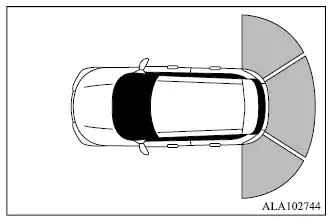
The rear parking sensor system uses sensors located in the rear bumper to detect nearby obstacles and sounds a warning tone to help inform the driver when an object is present behind the Mitsubishi Outlander.
When the "Auto Show Sensor" setting is turned on, the parking sensor view automatically appears in the multi-information display when the system becomes active.
WARNING
- The rear parking sensor system is intended only as a convenience aid and is not a substitute for proper parking procedures or direct observation of the area behind the vehicle.
- The driver remains fully responsible for safety while parking, reversing, or performing other low-speed maneuvers.
Always look around the Mitsubishi Outlander and confirm that the area is clear before and while backing up or parking.
- Read and understand the operating limitations of the rear parking sensor system described in this section. The different colors of the parking sensor indicator represent different approximate distances between the vehicle and the detected obstacle.
- Adverse weather or nearby ultrasonic noise sources, such as an automatic car wash, compressed-air brakes on a truck, or a pneumatic drill, may interfere with system operation. This can result in reduced detection performance or false warnings.
- The rear parking sensor system is designed to assist the driver in detecting relatively large stationary objects and to help reduce the possibility of vehicle damage while maneuvering.
- The rear parking sensor system is not designed to prevent contact with every small or moving object. Always reverse slowly and carefully. Objects located below bumper level, very close to the bumper, or directly on the ground may not be detected.
- The rear parking sensor system may have difficulty detecting soft or sound-absorbing objects such as snow, cloth, cotton, glass wool, and similar materials; thin objects such as rope, wire, or chain; and wedge-shaped objects.
- Maintain the tires at the specified inflation pressure. Incorrect tire pressure may affect vehicle height or sensor positioning and could interfere with normal operation. Differences in tire size may also prevent the parking sensor system from functioning as intended.
- If components other than MITSUBISHI MOTORS Genuine Parts are installed near the sensor areas, the parking sensor system may not operate normally.
If the Mitsubishi Outlander sustains damage to the rear bumper fascia that causes it to become bent, displaced, or misaligned, the sensor detection area may change. This can result in inaccurate obstacle distance measurements, missed detections, or false alarms.
CAUTION
- Excessive noise, including high audio-system volume or wind noise from an open window, may interfere with the warning tone and make it difficult or impossible to hear.
- Keep the parking sensors located in the rear bumper fascia free from snow, ice, mud, and heavy accumulations of dirt. Do not clean the sensors with sharp or abrasive objects. If the sensor surfaces are covered or damaged, rear parking sensor accuracy may be reduced.
System operation
When the shift lever is in the R (Reverse) position, the rear parking sensor system provides visual and audible warnings for obstacles detected behind the Mitsubishi Outlander.
The system is automatically deactivated when vehicle speed exceeds 6 MPH (10 km/h). Rear parking sensor operation becomes available again when the vehicle slows below that speed.
When an obstacle is first detected, a green indicator appears and flashes while an intermittent warning tone sounds. As the rear of the vehicle moves closer to the object, the indicator changes to yellow and flashes more rapidly, while the warning tone also increases in frequency. When the Mitsubishi Outlander is very close to the obstacle, the indicator changes to red and remains illuminated continuously, and the warning tone becomes continuous.
Example
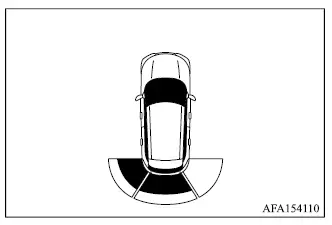
As the rear of the Mitsubishi Outlander approaches a detected obstacle, the corresponding parking sensor indicator appears in the multi-information display to show the affected detection area.
Example
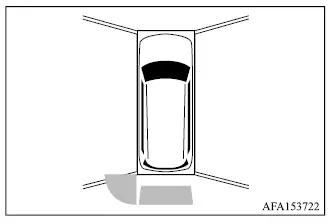
The rear parking sensor indicator is also displayed in the Multi Around Monitor view on the Smartphone-link Display Audio [SDA] screen, giving the driver an additional visual reference for obstacles detected behind the Mitsubishi Outlander.
How to enable/disable the rear parking sensor
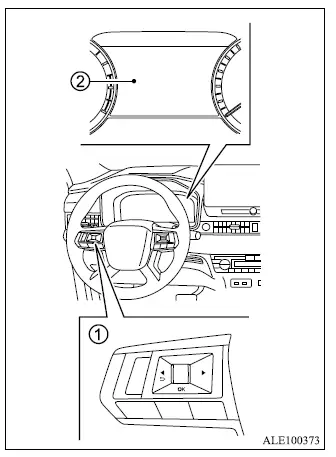
- Steering wheel remote control switches (left side)
- Multi-information display
The rear parking sensor system is automatically activated when the ignition switch is in the ON position and the shift lever is placed in R (Reverse).
Use the following procedure to enable, disable, or configure the rear parking sensor system:
1. Press the
 button until
"Settings"
appears in the multi-information display
2 and then push the scroll dial. Use the
scroll dial to select "Driver Assistance."
Then push the scroll dial.
button until
"Settings"
appears in the multi-information display
2 and then push the scroll dial. Use the
scroll dial to select "Driver Assistance."
Then push the scroll dial.
2. Select "Parking sensors" and push the scroll dial to open the parking sensor settings menu.
3. Use the scroll dial to move through the available settings and select or change the desired item:
- Moving Object (if so equipped)
- Turns Moving Object Detection (MOD) ON or OFF - Auto Show Sensor
- Automatically displays the parking sensor view in the multi-information display when the rear parking sensor system activates - Rear
- Turns the rear parking sensor system ON or OFF - Distance
- Changes the rear parking sensor detection distance to "Long", "Medium" or "Short" - Volume
- Changes the parking sensor warning tone volume to "High", "Medium" or "Low"
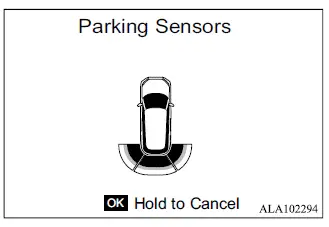
When the transmission is in R (Reverse) and the "Parking Sensors" screen is shown in the multi-information display, the parking sensor system can be temporarily disabled by pressing and holding the OK switch on the steering wheel for more than 3 seconds.
The rear parking sensor system automatically resumes operation under any of the following conditions:
- When the transmission is shifted to P (Park) or N (Neutral).
- When vehicle speed increases above approximately 6 MPH (10 km/h).
- When the Mitsubishi Outlander engine is restarted.
Rear parking sensor limitations
WARNING
- The following limitations apply to the rear parking sensor system.
Failure to operate the Mitsubishi Outlander with these limitations in mind could result in serious injury or death.
- Read and understand the rear parking sensor limitations described in this section. Adverse weather can affect ultrasonic sensor performance and may cause reduced detection capability or false warnings.
- The system is automatically deactivated at speeds above 6 MPH (10 km/h) and becomes available again when vehicle speed decreases below that level.
- Adverse weather or nearby ultrasonic noise sources, such as an automatic car wash, compressed-air brakes on a truck, or a pneumatic drill, may interfere with the rear parking sensors and cause reduced performance or unintended activation.
- The rear parking sensor system is not designed to prevent contact with every small or moving object. Always reverse the Mitsubishi Outlander slowly and carefully. Small objects positioned below the bumper or directly on the ground may not be detected.
- The rear parking sensor system may not reliably detect soft or sound-absorbing objects such as snow, cloth, cotton, or glass wool; thin objects such as rope, wire, or chain; wedge-shaped objects; objects with complex shapes; or several objects positioned very close together.
- The rear parking sensor system may not reliably detect obstacles when vehicle speed exceeds approximately 3 MPH (5 km/h). Certain angled or moving objects, irregularly shaped objects, or multiple objects positioned close together may also remain undetected.
- The parking sensor system may not operate correctly under the following conditions:
- When rain, snow, ice, dirt, or other material adheres to a parking sensor.
- When loud sounds or ultrasonic interference are present around the Mitsubishi Outlander.
- When the surface of the obstacle is angled diagonally relative to the rear of the vehicle.
- When a parking sensor or the surrounding area becomes extremely hot or extremely cold.
- The parking sensor system may activate unexpectedly under the following conditions:
- When tall or overgrown grass is present around the vehicle.
- When bumps, protrusions, manhole covers, or similar features are present on the road surface.
- When the Mitsubishi Outlander passes through a hanging flag, curtain, or similar flexible object.
- When snow or ice has accumulated behind the vehicle.
- When driving or maneuvering on a steep hill.
System temporarily unavailable
When the system detects that one or more rear parking sensors are blocked, the parking sensor system is automatically deactivated and a warning message appears in the multi-information display.
The rear parking sensor system remains unavailable until the condition preventing normal sensor operation has been cleared.
Temporary environmental conditions such as splashing water, mist, or fog may interfere with the parking sensors. The sensors can also be blocked by ice, water droplets, frost, dirt, or other material covering the sensing surfaces.
Action to take: When the obstruction or temporary environmental condition is no longer present, the rear parking sensor system on the Mitsubishi Outlander will automatically resume normal operation.
System maintenance
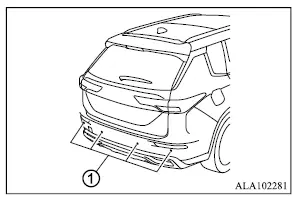
Parking sensors 1 are installed in the rear bumper of the Mitsubishi Outlander. Keep the sensor surfaces and the surrounding bumper areas clean to help maintain accurate obstacle detection.
If the parking sensors become dirty, carefully wipe them with a soft cloth, taking care not to scratch, strike, or otherwise damage the sensing surfaces.
The rear parking sensors may be temporarily affected by environmental conditions such as splashing water, mist, or fog.
Sensor blockage can also be caused by ice, water droplets, frost, dirt, or other debris covering the parking sensors.
Inspect the area around the rear parking sensors regularly and remove any material or object that could interfere with proper sensor operation.
Do not attach stickers, including transparent materials, install accessories, or apply additional paint to the parking sensors or the surrounding bumper areas. These modifications may interfere with ultrasonic detection and could cause improper operation or a system malfunction.
Do not subject the areas around the parking sensors to strong impacts, and do not remove, disassemble, or modify the sensors. If the sensors or surrounding parts of the rear bumper become deformed or damaged in an accident or other impact, have the parking sensor system inspected. It is recommended that you visit an authorized Mitsubishi Motors dealer for this service.
When washing the Mitsubishi Outlander with a high-pressure washer, do not direct the high-pressure water jet at the parking sensors. Excessive water pressure may damage the sensors or cause the rear parking sensor system to malfunction.
