WARNING
- Driving the Mitsubishi Outlander with tires that are worn, damaged, or incorrectly inflated is dangerous.
These tire conditions can adversely affect handling, braking, traction, stability, and overall vehicle performance.
They may also contribute to tread separation, sudden tire failure, or a blowout, which can lead to loss of vehicle control, a collision, serious injury, or death.
- Tires naturally deteriorate as they age, even when they are used infrequently or not used at all.
As a general guideline, tires more than 6 years old should be considered for replacement even when no visible damage or severe wear is apparent.
Understanding the following tire-related terms will help you inspect, maintain, and properly inflate the tires on your Mitsubishi Outlander:
- Cold tire pressure:
- The tire pressure measured after the vehicle has been parked for at least three hours, or
- The tire pressure measured after the vehicle has traveled less than 1 mile (1.6 km) following a parking period of at least three hours.
- Maximum pressure: the highest permissible cold inflation pressure specified for the tire.
- Recommended inflation pressure: the specified tire pressure intended to provide optimum tire performance under normal vehicle operating conditions.
- Intended outboard sidewall:
- The sidewall that has a whitewall, white lettering, or manufacturer, brand, and/or model-name markings that are raised higher or recessed deeper than corresponding markings on the opposite sidewall, or
- The outward-facing sidewall of an asymmetrical tire designed with one specific side that must always face outward when the tire is installed on the vehicle.
- Passenger car tire: a tire intended for use on passenger cars, multipurpose passenger vehicles, and trucks with a gross vehicle weight rating (GVWR) of 10,000 pounds or less.
- Light truck (LT) tire: a tire identified by its manufacturer as primarily intended for use on lightweight trucks or multipurpose passenger vehicles.
- Tread: the portion of the tire that makes direct contact with the road surface.
- Tread rib: a raised section of tread that extends circumferentially around the tire.
- Tread separation: a condition in which the tread begins to pull away from the tire carcass.
- Carcass: the structural body of the tire, excluding the tread and sidewall rubber, that supports the load when the tire is properly inflated.
- Sidewall: the portion of the tire located between the tread and the bead.
- Section width: the straight-line distance between the outer surfaces of the sidewalls of an inflated tire, excluding raised areas created by labeling, decorative features, or protective bands.
- Bead: the part of the tire made with steel wires wrapped or reinforced by ply cords and shaped to fit securely against the wheel rim.
- Ply: a layer consisting of parallel cords coated with rubber.
- Cord: the individual strands that form the tire plies.
- Rim: the metal support for a tire, or tire-and-tube assembly, on which the tire beads are seated.
- Rim diameter: the nominal diameter of the rim bead seat.
- Groove: the recessed space between two adjacent tread ribs.
Tire Pressure Monitoring System [TPMS]
The Mitsubishi Outlander is equipped with a Tire Pressure Monitoring System [TPMS] that monitors the inflation pressure of all tires. If the low tire pressure warning light illuminates and the "Tire Pressure Low - Add Air" warning message appears in the multi-information display, one or more tires is significantly under-inflated.
The TPMS becomes active when the Mitsubishi Outlander is driven at speeds above 16 MPH (25 km/h). Because the system requires operating conditions that allow it to monitor tire pressure, it may not detect an abrupt loss of pressure immediately, such as a sudden flat tire that occurs while driving.
Tire checking before driving
Before driving, inspect all tires for excessive tread wear, irregular or uneven wear patterns, and visible damage. Check the tread for embedded stones, nails, glass, or other foreign objects. Examine the tread and sidewalls for cuts, cracks, bulges, or other signs of deterioration. Confirm that the wheel nuts are properly tightened and that every tire is inflated to the correct pressure. Replace worn or damaged tires before they reach a condition that could compromise safe vehicle operation.
Because the Mitsubishi Outlander is equipped with a Tire Pressure Monitoring System [TPMS], special care must be taken when removing or installing a tire on the wheel. The tire inflation pressure sensor can be damaged during tire replacement if proper service procedures and suitable equipment are not used.
Tire replacement should be performed only by a certified Mitsubishi dealer or another qualified tire service facility familiar with the Mitsubishi Outlander and its Tire Pressure Monitoring System [TPMS]. Proper procedures and suitable equipment are important to avoid damage to the tire, wheel, or pressure sensor during removal and installation.
Tire Markings
Example
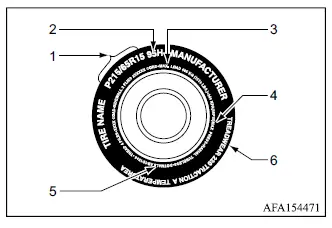
- Size Designation
- Service Description
- Maximum Load
- Maximum Pressure
- U.S. DOT Safety Standards Code (TIN)
- Treadwear, Traction and Temperature Grades
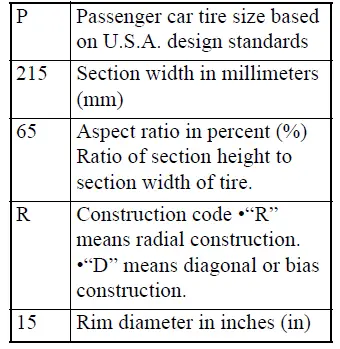
Size Designation
EXAMPLE: P215/65R15
NOTE
- European/Japanese metric tire sizing is based on European and Japanese design standards. Tires manufactured to these standards display the size on the sidewall beginning directly with the section width, without the letter "P" at the beginning of the designation.
Example: 215/65R15 96H.
- LT (Light Truck) metric tire sizing is based on U.S. design standards. The format is similar to a P-metric tire designation, except the letters "LT" are molded into the sidewall immediately before the tire size.
Example: LT235/85R16.
Service Description
EXAMPLE: 95H
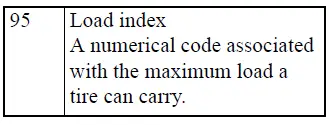
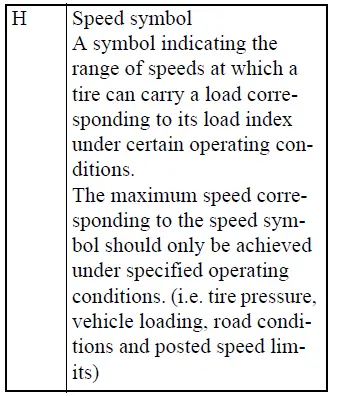
Maximum Load
Maximum load indicates the greatest load that the tire is designed and rated to carry under the specified operating conditions.
WARNING
- Overloading a tire is dangerous. Excessive load can cause overheating or tire failure, adversely affect Mitsubishi Outlander handling and stability, and increase braking distance. Always use tires with the recommended load capacity for the vehicle.
Never exceed the permitted tire load.
Maximum Pressure
Maximum Pressure identifies the highest permissible cold tire inflation pressure specified for that particular tire.
Tire Identification Number (TIN)
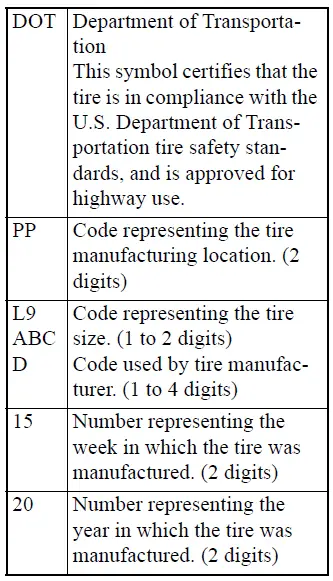
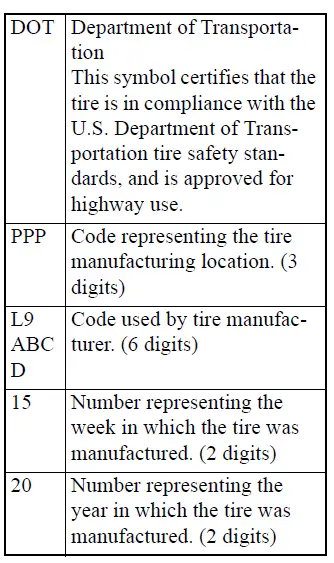
The Tire Identification Number (TIN) may be molded into one or both sidewalls of the tire, although the date code may appear on only one side. First inspect the outboard sidewall of a tire installed on the Mitsubishi Outlander. If the complete TIN is not visible there, check the inboard sidewall.
EXAMPLE: DOT PP L9 ABCD 1504
EXAMPLE (13 digits type): DOT PPP L9 ABCD 1504
Treadwear, Traction and Temperature Grades
Treadwear
The treadwear grade is a comparative rating based on the wear rate of a tire tested under controlled conditions on a specified government test course. For example, a tire with a treadwear grade of 150 would be expected to wear one and one-half (1-1/2) times as well on the government test course as a tire graded 100.
Actual tire life can differ substantially from the test rating because real-world performance depends on operating conditions. Driving style, maintenance practices, inflation pressure, wheel alignment, road surfaces, climate, and other factors can all cause actual tread life to vary from the standardized comparison.
Traction
Traction grades, listed from highest to lowest, are AA, A, B, and C. These grades indicate a tire's ability to stop on wet pavement when tested under controlled conditions on specified government asphalt and concrete test surfaces. A tire with a C rating may provide comparatively low wet-pavement traction performance.
Temperature
Temperature grades are A, the highest rating, followed by B and C. They indicate the tire's resistance to heat generation and its ability to dissipate heat when tested under controlled conditions on a specified indoor laboratory test wheel. Prolonged exposure to high temperature can cause tire materials to deteriorate and shorten tire service life, while excessive heat buildup can contribute to sudden tire failure. Grade C represents a performance level that all passenger car tires must meet under Federal Motor Vehicle Safety Standard No. 109. Grades B and A indicate progressively higher levels of performance on the laboratory test wheel than the minimum required by law.
Tire inflation pressures
Correct tire inflation pressure is essential for the safe, efficient, and predictable operation of the Mitsubishi Outlander. Incorrect tire pressure can create problems in three major areas:
- Safety
Insufficient tire pressure causes excessive sidewall flexing, which can lead to overheating, structural damage, and eventual tire failure. Excessive pressure reduces the tire's ability to absorb impacts from road irregularities. Potholes, debris, and other road hazards may then cause damage that can also result in tire failure. - Economy
Incorrect tire pressure can produce uneven or abnormal tread wear. These wear patterns shorten tire life and may require replacement sooner than expected.Under-inflated tires also create greater rolling resistance, which makes the Mitsubishi Outlander work harder to move and can increase fuel consumption.
- Ride comfort and vehicle stability
The ride quality and handling characteristics designed into the Mitsubishi Outlander depend in part on maintaining the correct tire pressures.Excessive tire pressure can make the ride harsh, stiff, and uncomfortable.
Insufficient tire pressure can make vehicle responses feel slower and less precise.
Unequal inflation pressure between tires can also make steering response uneven and less predictable.
The recommended tire inflation pressure for the Mitsubishi Outlander under normal driving conditions is shown on the Tire and Loading Information placard attached to the driver's door sill.
Use the specified inflation pressures for the applicable tires during normal vehicle operation.
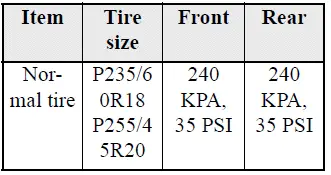
Check the inflation pressure of all tires at least once a month and adjust the pressure when necessary.
Check tire pressures more frequently when outside temperatures change significantly, because inflation pressure naturally rises and falls with changes in ambient temperature.
The recommended pressures are specified as "cold inflation pressure".
Cold inflation pressure is the pressure measured after the Mitsubishi Outlander has been parked for at least three hours, or after it has been driven less than 1 mile (1.6 km) following a parking period of at least three hours.
Cold tire inflation pressure must never exceed the maximum pressure molded into the tire sidewall. After the vehicle has been driven for several miles, tire pressure may normally increase by approximately 2 to 6 psi (14 to 41 kPa) above the cold inflation pressure.
Do not release air from a warm tire simply to reduce it to the specified cold pressure. Doing so will leave the tire under-inflated after it cools.
Visually inspect the tires whenever you refuel. If one tire appears lower than the others, check the inflation pressure of all tires rather than relying only on appearance.
Observe the following tire safety precautions:
- Maintain all tires at the recommended inflation pressures.
- Do not exceed the recommended vehicle or tire load limits.
- Distribute cargo and other loads as evenly as practical throughout the Mitsubishi Outlander.
- Drive at speeds appropriate for road, traffic, weather, and tire conditions.
- After adjusting the tires to the correct pressure, inspect them for visible damage and air leakage. Reinstall the valve stem caps securely after checking or inflating the tires.
Replacing tires and wheels
CAUTION
- Do not install tires of a different size from those specified for the Mitsubishi Outlander, and do not combine different tire types. Mixing incompatible tire sizes or constructions can adversely affect handling, stability, and overall driving safety.
- Always use tires of the same size, type, and brand, with no significant differences in tread wear.
Using tires that differ in size, construction, brand, or degree of wear can increase differential oil temperature and may damage the driving system. Unequal tires can also place excessive loads on drivetrain components, potentially causing oil leakage, component seizure, or other serious mechanical problems.
- Use Mitsubishi Motors genuine wheels because the Mitsubishi Outlander is equipped with a Tire Pressure Monitoring System [TPMS].
Using an unsuitable wheel may prevent the tire pressure sensor from being installed or sealed correctly, creating a risk of air leakage, sensor damage, or improper TPMS operation.
Tire maintenance
The following maintenance practices are recommended to help promote even tire wear, predictable handling, and longer tire life on the Mitsubishi Outlander:
- Check tire inflation pressures regularly and correct them whenever necessary.
- Have wheel balance and front and rear suspension alignment inspected and maintained at appropriate intervals.
- Rotate the tires regularly in accordance with the procedure described in "Tire rotation".
Tread wear indicator
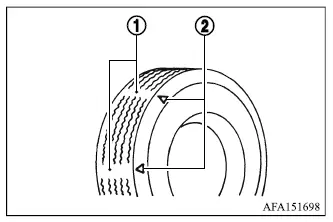
- Tread wear indicator
- Location of the tread wear indicator
Tread wear indicators are molded into the original equipment tires fitted to the Mitsubishi Outlander to help show when the tread has worn to the point where tire replacement is required.
Many states have regulations requiring tires to be replaced once the tread has worn to this level.
The indicators are molded into the bottoms of the tread grooves and become visible across the tread when the remaining tread depth reaches approximately 1/16 inch (1.6 mm).
If the tread wear indicator bands become visible next to one another in two or more locations around the tire, replace the affected tire.
NOTE
- The appearance, identifying marks, and exact locations of tread wear indicators may vary depending on the tire manufacturer.
Tire rotation
To promote more even tread wear and extend overall tire service life, Mitsubishi Motors Corporation recommends rotating the tires at the mileage intervals specified in the "WARRANTY AND MAINTENANCE MANUAL".
The appropriate rotation interval can vary depending on the condition of the Mitsubishi Outlander, road surfaces, operating environment, and individual driving habits.
If unusual, accelerated, or uneven tread wear becomes noticeable, have the tires rotated and inspected as soon as practical rather than waiting for the next scheduled interval.
Whenever the tires are rotated, inspect them for uneven wear, visible damage, and signs of incorrect wheel alignment. Abnormal tread wear can result from improper tire inflation, incorrect wheel alignment, wheel imbalance, severe braking, or other operating conditions.
If the cause of uneven tread wear is not apparent, consult a certified Mitsubishi dealer so the tires, wheels, and related suspension components can be inspected.
The first tire rotation is particularly important because it helps establish a more even wear pattern among all four tires early in their service life.
Tires that do not have arrows showing rotation direction
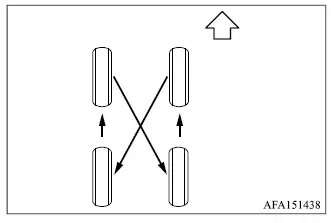
Tires that have arrows showing rotation direction
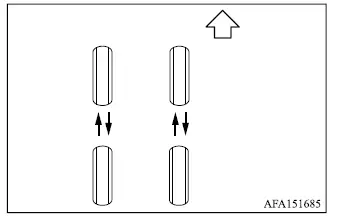
Wheel nut tightening torque: 73 to 93 ft-lb (98 to 127 Nꞏm)
WARNING
- After rotating the tires, do not use the Tire fill notification function to set or adjust tire inflation pressure.
Instead, use an accurate tire pressure gauge and adjust each tire to the specified pressure shown on the Tire and Loading Information label.
- To maintain proper operation of the Tire fill notification system after tire rotation, the tire pressure sensors must be reset and registered to their new installed positions. It is recommended that you visit an authorized Mitsubishi Motors dealer for this service.
CAUTION
- If the tires have arrows (A) indicating their required direction of rotation, move the front and rear tires only within the same side of the Mitsubishi Outlander. Exchange the front and rear tires on the left side separately from those on the right side. Each tire must remain on its original side of the vehicle. When reinstalling the tires, make sure every directional arrow points in the direction the wheel rotates when the vehicle moves forward. A directional tire installed backward may not provide its intended performance.
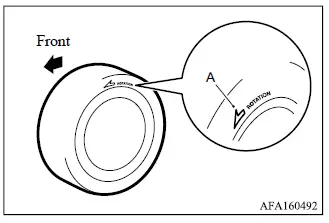
- Do not combine different tire types on the Mitsubishi Outlander. Mixing tires with different constructions, characteristics, or intended uses can adversely affect handling, stability, braking, and overall vehicle safety.
Spare tire (if so equipped)
Temporary-use spare tire (if so equipped)
The type of spare tire supplied with the Mitsubishi Outlander depends on the specific model and vehicle configuration.
Spare tire label (if so equipped)
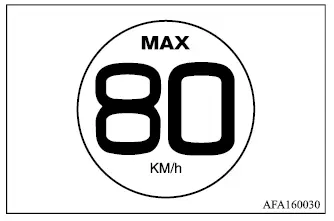
A temporary-use spare tire, which is a different size from the original road tires, may be supplied with the Mitsubishi Outlander.
If the temporary spare tire must be installed, observe all of the following precautions carefully. Improper use of the spare tire can affect vehicle handling, cause damage, or increase the risk of an accident.
Because the temporary spare tire is not equipped with a TPMS sensor, the Tire Pressure Monitoring System [TPMS] will not function normally while the spare tire is installed.
CAUTION
- The temporary spare tire is intended only for emergency use.
Replace it with the correct standard tire as soon as practical.
- Drive the Mitsubishi Outlander carefully while the temporary spare tire is installed, as vehicle handling may differ from normal.
- Avoid sudden steering inputs, sharp turns, hard braking, and other abrupt maneuvers while driving with the spare tire.
- Check the inflation pressure of the T-type temporary spare tire periodically and maintain it at 420 kPa (4.2 kgf/cm2).
- Do not drive the vehicle at speeds above 80 km/h while the temporary spare tire is installed.
- Do not install tire chains on the temporary spare tire. Tire chains will not fit correctly and may damage the tire, wheel, or surrounding vehicle components.
- Because the temporary spare tire is smaller than the original road tire, vehicle ground clearance is reduced. Avoid driving over curbs, large bumps, deep ruts, or other obstacles that could contact the underside of the Mitsubishi Outlander. Do not take the vehicle through an automatic car wash while the temporary spare tire is installed because the vehicle may become caught or damaged.
- Do not install the Mitsubishi Outlander temporary spare tire on another vehicle.
- Never use more than one temporary spare tire on the vehicle at the same time.
Conventional spare tire (if so equipped)
A conventional spare tire, the same size as the original road tire, may be supplied with the Mitsubishi Outlander depending on the model and equipment configuration.
Because the conventional spare tire is not equipped with a TPMS sensor, the Tire Pressure Monitoring System [TPMS] will not function normally while that spare tire is mounted.
Snow tires
Snow tires may be required by law in certain regions during winter. If snow tires are necessary, install tires that are the same size and type as the original tires specified for the Mitsubishi Outlander. Snow tires should be fitted to all four wheels rather than only one axle.
Using unmatched winter tires or installing them on fewer than four wheels can reduce vehicle stability, handling consistency, and overall driving safety.
Even where local regulations permit higher speeds, do not operate snow tires continuously at speeds above 75 MPH (120 km/h).
CAUTION
- Use Mitsubishi Motors genuine wheels because the Mitsubishi Outlander is equipped with a Tire Pressure Monitoring System [TPMS].
An unsuitable wheel may not allow the tire pressure sensor to be installed or sealed correctly, creating a risk of air leakage, sensor damage, or improper TPMS operation.
Tire chains
CAUTION
- Tire chains cannot be used on the Mitsubishi Outlander.
There is insufficient clearance between the tires, chains, and surrounding body components for safe installation. Using tire chains could cause contact with and damage to the vehicle body or other components.
Jacking up the vehicle
A jack is not supplied as standard equipment with the Mitsubishi Outlander.
If a jack is required, purchase a Mitsubishi Genuine jack specifically designed for your vehicle from an authorized Mitsubishi Motors dealer.
WARNING
- Before using a jack, carefully read and follow the instructions in this section as well as the instruction manual supplied with the jack.
- Never use a jack other than the Mitsubishi Genuine jack specifically designed and specified for the Mitsubishi Outlander.
- The Mitsubishi Genuine jack is intended only for temporarily lifting the vehicle during a tire change.
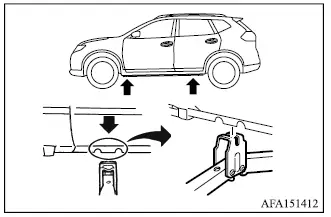
- Never raise the Mitsubishi Outlander from any location other than the specified jack-up points. Incorrect jack placement can damage the vehicle or cause it to become unstable.
Jack-up point