
WARNING
- Failure to follow the warnings and instructions for proper use of the FCM system could result in serious injury or death.
- The FCM system is designed only as a supplemental driver-assistance feature. It does not replace the driver's responsibility to monitor traffic conditions, remain attentive, and operate the Mitsubishi Outlander safely. The system cannot prevent every accident, particularly those caused by careless, inattentive, or unsafe driving.
- The FCM system cannot operate effectively under every combination of driving, traffic, weather, and road conditions. The driver must remain prepared to brake, steer, or otherwise take control whenever necessary.
The Forward Collision Mitigation System [FCM] can assist the driver when it detects a potential risk of a forward collision with:
- a vehicle traveling ahead in the same lane
- a pedestrian ahead in the traveling lane
- a cyclist ahead in the traveling lane
- a stationary motorcyclist positioned ahead in the traveling lane
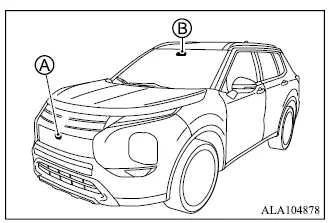
The FCM system uses radar sensor A located at the front of the Mitsubishi Outlander to measure the distance to a vehicle traveling ahead in the same lane.
For pedestrian detection, the FCM system also uses camera B installed behind the windshield together with the front radar sensor to monitor the area ahead.
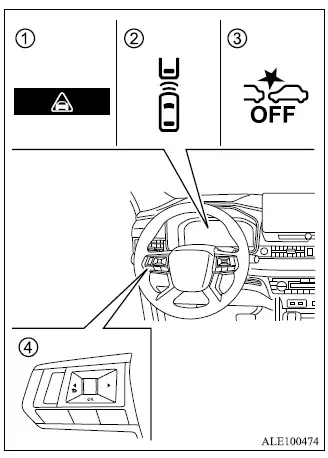
- FCM emergency warning indicator
- Vehicle ahead detection indicator (on the multi-information display)
- FCM system OFF warning light (on the meter panel)
- Steering wheel remote control switches (left side)
FCM system operation
If the FCM system detects a risk of a forward collision, it first alerts the driver by flashing the vehicle ahead detection indicator in yellow on the multi-information display and sounding an audible warning. At the same time, the system can apply partial braking to begin reducing vehicle speed.
If the driver responds to the warning by applying the brake pedal quickly and firmly, and the FCM system determines that a forward collision is still possible, it can automatically increase braking force to assist the driver's braking effort.
If the driver does not respond sufficiently, the FCM system provides a stronger warning by flashing the FCM emergency warning indicator in red and white on the multi-information display while sounding an audible alert.
The system can then apply partial braking to help reduce the closing speed between the Mitsubishi Outlander and the detected obstacle ahead.
If the risk of collision becomes imminent, the FCM system can automatically apply stronger braking within its operating limits.
During FCM operation, brake-system sounds may be heard. This is a normal characteristic of the system and indicates that braking assistance is being applied.
The FCM system operates when the Mitsubishi Outlander is traveling at speeds above approximately 6 MPH (10 km/h).
For pedestrian and cyclist detection, the FCM system operates within a vehicle speed range of approximately 6 to 50 MPH (10 to 80 km/h).
For stationary motorcyclist detection, the FCM system operates within a vehicle speed range of approximately 6 to 43 MPH (10 to 70 km/h).
NOTE
- The vehicle's stop lights illuminate whenever braking is automatically performed by the FCM system.
- When the FCM system detects an obstacle in the vehicle's path and displays an FCM warning, a sound may be heard from the engine compartment as the braking system prepares for faster brake response.
Depending on the Mitsubishi Outlander speed, the distance to the vehicle, pedestrian, cyclist, or stationary motorcyclist ahead, and the surrounding driving and roadway conditions, the FCM system may help the driver avoid a forward collision or reduce the severity of an impact when a collision cannot be completely avoided.
If the driver is actively steering, accelerating, or braking, FCM intervention may occur later than usual or may not occur, depending on the driver's inputs and the surrounding conditions.
If the FCM system automatically brings the Mitsubishi Outlander to a complete stop, the vehicle remains stationary for approximately 2 seconds before the brakes are released.
When the brake pedal is depressed while automatic braking is being applied by the system, the driver may notice a change in pedal resistance and may hear operating sounds or feel vibration. These sensations are normal during FCM operation and do not indicate a malfunction. Additional braking force can be applied by pressing the brake pedal more firmly.
Automatic braking will stop under any of the following conditions:
- When the steering wheel is turned sufficiently to avoid the potential collision.
- When the accelerator pedal is depressed.
- When the system no longer detects a vehicle or pedestrian ahead.
Turning the FCM system ON/OFF
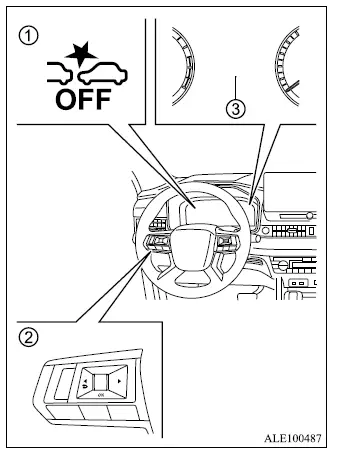
- FCM system OFF warning light (on the meter panel)
- Steering wheel remote control switches (left side)
- Multi-information display
Use the following procedure to turn the Forward Collision Mitigation System [FCM] on or off.
1. Press the
 button until
"Settings"
appears in the multi-information display
3, and then push the scroll dial.
button until
"Settings"
appears in the multi-information display
3, and then push the scroll dial.
2. Use the scroll dial to select "Driver Assistance." Then push the scroll dial to open the menu.
3. Select "Emergency Brake" and push the scroll dial.
4. Select "Front" and use the scroll dial to turn the FCM system on or off.
When the FCM system is switched off, the FCM system OFF warning light 1 illuminates to indicate that forward collision mitigation is unavailable.
NOTE
- If the ASC system is disabled, the FCM system becomes unavailable regardless of the FCM setting selected in the multi-information display.
- The FCM system is automatically turned ON whenever the Mitsubishi Outlander engine is restarted.
- The Predictive Forward Collision Warning [PFCW] system is integrated with the FCM system and does not have a separate setting in the display. When FCM is turned off, PFCW is also turned off.
- The FCM system cannot be switched off while the vehicle is being driven.
- When MI-PILOT Assist is activated, the FCM system automatically turns ON as part of the active driver-assistance operation.
After MI-PILOT Assist is canceled, the FCM system automatically returns to the setting previously selected by the driver.
FCM system limitations
WARNING
- The FCM system has the limitations described below. Failure to operate the Mitsubishi Outlander with these limitations in mind could result in serious injury or death.
- The FCM system cannot detect every vehicle, pedestrian, cyclist, or motorcyclist under all driving and environmental conditions.
- The FCM system is not designed to detect the following types of road users or objects reliably:
- Small pedestrians, including small children, and animals.
- Pedestrians using wheelchairs or other personal mobility devices, including scooters, child-operated ride-on toys, or skateboards.
- Pedestrians who are seated, crouched, or otherwise not in a normal upright standing or walking position.
- Vehicles crossing the Mitsubishi Outlander path.
- Objects or obstacles located along the roadside.
- Parked vehicles.
- The FCM system has performance limits that vary according to vehicle speed and the type of object detected.
- If a stationary vehicle is located in the Mitsubishi Outlander path, FCM will not operate when vehicle speed exceeds approximately 50 MPH (80 km/h).
- Pedestrian detection may not operate correctly in darkness or inside tunnels, even when street or tunnel lighting is present.
- The FCM system may not recognize a narrow vehicle ahead, such as a motor tricycle or electric scooter.
- The FCM system may not operate if the speed difference between the Mitsubishi Outlander and the vehicle ahead is too small.
- When a pedestrian is detected, the FCM system will not provide the first-stage warning.
- The FCM system may fail to operate correctly, may not detect a vehicle, pedestrian, cyclist, or motorcyclist ahead, or may incorrectly identify another object with a similar shape under the following conditions:
- In dark or poorly illuminated conditions, including nighttime or tunnels, particularly when the Mitsubishi Outlander headlights are off or dim, or when the tail lights of the vehicle ahead are not illuminated.
- When the front camera is misaligned or its viewing direction has been altered.
- When visibility is reduced by rain, snow, fog, dust storms, sandstorms, or road spray from other vehicles.
- When driving down a steep slope or on roads with sharp curves.
- When driving over rough or uneven surfaces, such as an unpaved dirt road.
- When dirt, ice, snow, fog, or other material covers the radar sensor area or the windshield area used by the front camera.
- When interference from other radar sources affects the front radar sensor.
- When strong light, such as direct sunlight or high beams from an oncoming vehicle, enters the front camera. Strong lighting can create deep shadows around a pedestrian, cyclist, or motorcyclist and make detection more difficult.
- When a sudden change in brightness occurs.
For example, detection performance may be affected when the Mitsubishi Outlander enters or exits a tunnel or shaded area, or when a lightning flash causes a sudden change in surrounding brightness.
- When the vehicle is traveling on a slippery road surface.
- When the Mitsubishi Outlander is being driven on a slope.
- When excessively heavy baggage or cargo is loaded in the rear seat or cargo area and affects normal vehicle behavior.
However, the system may not always recognize when a sensor area is obstructed by ice, snow, stickers, or similar material. Under these conditions, FCM may not be able to detect hazards or warn the driver correctly. Check the radar and camera areas regularly and keep them clean and unobstructed.
- Painted surfaces, shadows, or patterns on the road, roadside, or walls, including faded, unusual, or temporary road markings.
- Shapes created by road structures ahead, such as tunnels, viaducts, traffic signs, vehicle-mounted reflectors, reflective sheets, and guardrails, as well as roadside objects such as trees and buildings or nearby light sources.
- Shapes or visual patterns formed by roadside trees, lighting, shadows, buildings, or similar objects that the camera or radar may interpret incorrectly.
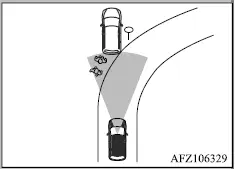
- Roadside objects such as traffic signs, guardrails, pedestrians, cyclists, motorcycles, vehicles, and similar objects.
- Objects positioned above the roadway, including low bridges, overhead traffic signs, and similar structures.
- Objects located on the road surface, such as railroad tracks, drainage grates, steel plates, or similar features.
- Objects inside parking structures, including beams, pillars, and other fixed structural elements.
- Pedestrians, cyclists, or motorcycles approaching or entering the Mitsubishi Outlander's travel lane.
- Pedestrians and cyclists encountered while driving through narrow alleys or similarly confined roadways.
- Pedestrians and cyclists who temporarily move toward or into the driving lane to avoid obstacles along the side of the road.
- Objects located on or close to the roadway, including trees and similar roadside features.
- Vehicles, pedestrians, cyclists, motorcycles, or other objects traveling in an adjacent lane or positioned close to the Mitsubishi Outlander.
- Pedestrians, cyclists, or motorcyclists approaching from the opposite direction.
- Braking distance becomes longer on slippery road surfaces, reducing the amount of distance available for the FCM system and driver to respond.
- Do not use the FCM system while towing a trailer. Under these conditions, the system may not reliably detect a vehicle traveling ahead.
- Do not use the FCM system when one or more tires are not in normal operating condition, including excessive tire wear, low tire pressure, installation of tire chains, or use of non-standard wheels.
- Excessive noise inside or outside the vehicle may interfere with the FCM warning chime and make the audible alert difficult or impossible to hear.
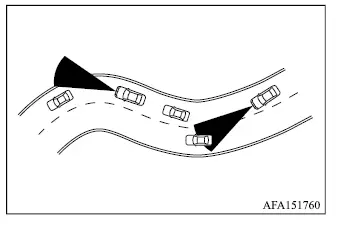
When driving on certain roads, including winding, hilly, curved, or narrow roads, roads under construction, or roads with significant slopes, the FCM sensors may detect a vehicle traveling in another lane or may temporarily fail to detect a vehicle directly ahead. Under these conditions, the system may respond unexpectedly or operate differently from what the driver anticipates.
Vehicle detection can also be influenced by the way the Mitsubishi Outlander is being driven, including steering movements and the vehicle's position within the lane, as well as by the condition of the vehicle itself. If sensor detection is affected, the system may unexpectedly flash the warning indicator and sound the warning chime. The driver must remain prepared to control vehicle speed manually and maintain a safe distance from traffic ahead.
