
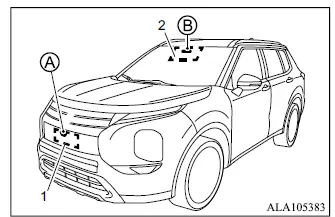
The radar sensor A is located at the front of the Mitsubishi Outlander, while camera B is mounted near the upper portion of the windshield.
To help ensure proper operation of the FCM system and reduce the risk of sensor-related malfunctions, observe the following precautions:
- Always keep the areas around radar sensor (1) and camera (2), including the corresponding sections of the front of the vehicle and windshield, clean and unobstructed.
- Do not strike, impact, or otherwise damage the areas surrounding radar sensor (1) and camera (2), including the front of the vehicle and windshield.
Damage in these areas can affect the ability of the FCM system to detect objects correctly.
- Do not cover the sensor areas or attach stickers, including transparent materials, or similar objects to the front of the vehicle near radar sensor (1) or camera (2).
Such items may interfere with sensor operation and could cause the FCM system to fail or malfunction.
- Do not install metallic objects near radar sensor (1) or camera (2), including brush guards, metallic accessories, stickers, or similar materials. Objects placed in these areas may interfere with detection and cause improper system operation.
- Do not place reflective materials, such as white paper or a mirror, on the instrument panel. Reflected sunlight may enter the camera and reduce its ability to detect vehicles, pedestrians, lane features, or other objects correctly.
- Do not modify, remove, or paint the front of the Mitsubishi Outlander near the radar sensor area. Before customizing, repairing, or restoring this part of the vehicle, it is recommended that you consult an authorized Mitsubishi Motors dealer.
- If radar sensor A, camera B, or the surrounding areas (1) and (2) are damaged in an accident, the FCM system may malfunction and may not provide the expected assistance. Have the affected components inspected before relying on the system again.
Radio frequency statement
For USA
Type approval number:
FCC ID: NF3-F5CP32
This device complies with Part 15 of the FCC Rules.
Operation is subject to the following two conditions:
1. This device may not cause harmful interference; and
2. This device must accept any interference received, including interference that may cause undesired operation.
CAUTION
- Changes or modifications to this equipment that are not expressly approved by Robert Bosch GmbH may void the FCC authorization to operate the equipment.
This equipment has been tested and found to comply with the limits established for a Class A digital device pursuant to Part 15 of the FCC Rules.
These limits are intended to provide reasonable protection against harmful interference when the equipment is operated in a commercial environment. This equipment generates, uses, and can radiate radio frequency energy. If it is not installed and operated in accordance with the instruction manual, it may cause harmful interference to radio communications.
Operation of this equipment in a residential environment is likely to cause harmful interference. If such interference occurs, the user may be required to correct the interference at their own expense.
Radio frequency radiation exposure information: This equipment complies with FCC radiation exposure limits established for an uncontrolled environment. It should be installed and operated with a minimum separation distance of 20 cm between the radiator and the user's body.
This transmitter must not be co-located with, or operated in conjunction with, any other antenna or transmitter.
For Canada
Type approval number:
IC: 3887A-F5CP32
Legal warning text for RF equipment: This device contains licence-exempt transmitter(s)/receiver(s) that comply with Innovation, Science and Economic Development Canada's applicable licence-exempt RSS standards. Operation is subject to the following two conditions: (1)
This device may not cause interference. (2)
This device must accept any interference received, including interference that may cause undesired operation of the device.
L'émetteur/récepteur exempt de licence contenu dans le présent appareil est conforme aux CNR d'Innovation, Sciences et Développement économique Canada applicables aux appareils radio exempts de licence.
L'exploitation est autorisée aux deux conditions suivantes : (1) L'appareil ne doit pas produire de brouillage; (2) L'appareil doit accepter tout brouillage radioélectrique subi, même si le brouillage est susceptible d'en compromettre le fonctionnement.
