
WARNING
- Failure to follow the warnings and instructions for proper use of the Rear AEB system could result in serious injury or death.
- The Rear AEB system is intended only as a supplemental driver-assistance feature and does not replace proper reversing procedures. Always check the side and rear mirrors, turn your head, and look in the direction the Mitsubishi Outlander will move before and while backing up. Never rely solely on Rear AEB. The driver remains responsible for staying alert, reversing safely, and maintaining control of the vehicle at all times.
- The Rear AEB system has operating limitations and cannot prevent every collision or respond effectively in all situations.
The Rear Automatic Emergency Braking [Rear AEB] system can assist the driver while the Mitsubishi Outlander is backing up and approaching an object detected directly behind the vehicle.
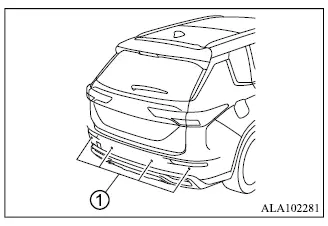
The Rear AEB system detects obstacles behind the Mitsubishi Outlander using sensors 1 installed in the rear bumper.
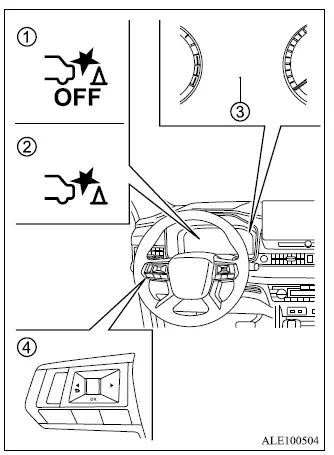
- Rear AEB system OFF warning light
- Rear AEB system warning indicator
- Multi-information display
- Steering wheel remote control switches (left side)
Rear AEB system operation
The Rear AEB system operates when the shift lever is in the R (Reverse) position and vehicle speed is below approximately 9 MPH (15 km/h).
If the system detects a risk of collision with an obstacle while the Mitsubishi Outlander is backing up, Rear AEB warning indicator 2 flashes in multi-information display 3 and a warning chime sounds three times. The system then automatically applies the brakes to help reduce the risk or severity of a collision.
After the automatic braking intervention, the driver must press the brake pedal to maintain braking pressure and keep the vehicle stopped as necessary.
NOTE
- The vehicle's stop lights illuminate whenever braking is automatically performed by the Rear AEB system.
- A braking-system operating sound may be heard when Rear AEB applies the brakes. This is normal and does not indicate a malfunction.
Turning the Rear AEB system ON/OFF
Use the following procedure to turn the Rear AEB system ON or OFF.
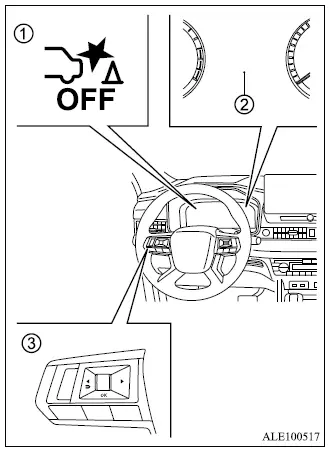
- Rear AEB system OFF warning light
- Multi-information display
- Steering wheel remote control switches (left side)
1. Press the
 button until
"Settings"
appears in multi-information display
2, and then push the scroll dial. Use the
scroll dial to select "Driver Assistance."
Then push the scroll dial.
button until
"Settings"
appears in multi-information display
2, and then push the scroll dial. Use the
scroll dial to select "Driver Assistance."
Then push the scroll dial.
2. Select "Emergency Brake" and push the scroll dial to open the related settings.
3. To turn the Rear AEB system on or off, use the scroll dial to select or clear the checkbox for "Rear".
When the Rear AEB system is turned off, Rear AEB system OFF warning light 1 illuminates to indicate that automatic rear emergency braking is unavailable.
NOTE
- The Rear AEB system is automatically turned on whenever the Mitsubishi Outlander engine is restarted.
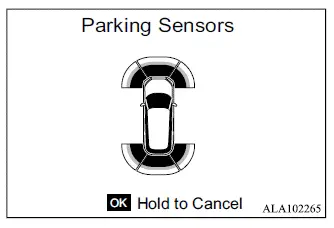
When the transmission is in R (Reverse) and the "Parking Sensors" screen is displayed in the multi-information display, the Rear AEB system can be temporarily disabled by pressing and holding the OK switch on the steering wheel for more than 3 seconds.
The Rear AEB system automatically resumes operation under any of the following conditions:
- When the transmission is shifted to P (Park) or N (Neutral).
- When vehicle speed increases above approximately 6 MPH (10 km/h).
- When the engine is restarted.
Rear AEB system limitations
WARNING
- The Rear AEB system has the limitations listed below. Failure to understand and follow these warnings and operating instructions could result in serious injury or death.
- If the Mitsubishi Outlander approaches an obstacle while the accelerator or brake pedal is being pressed, Rear AEB may not operate, or its intervention may be delayed. System performance can also be reduced by vehicle condition, driving conditions, surrounding traffic, weather, road surface conditions, and other factors. Never wait for Rear AEB to intervene. Apply the brake pedal yourself as soon as braking is necessary.
- If Rear AEB operation must be overridden, press the accelerator pedal firmly.
- Always check the area around the Mitsubishi Outlander and physically look behind the vehicle before and while reversing. Rear AEB is designed primarily to detect certain stationary objects behind the vehicle and does not detect the following types of objects reliably:
- Moving objects
- Objects positioned too low for reliable detection
- Narrow objects
- Wedge-shaped objects
- Objects with complex or irregular shapes
- Multiple objects positioned very close together
- Objects located extremely close to the rear bumper, at less than approximately 1 ft (30 cm)
- Objects that suddenly enter the sensor detection area
- Thin objects such as rope, wire, chain, or similar materials
- The Rear AEB system may not operate correctly for certain types or positions of obstacles, including:
- Obstacles located high above the ground
- Obstacles positioned away from the direct rearward path of the vehicle
- Obstacles with soft or sound-absorbing surfaces, such as spongy materials or snow, which may reduce the effectiveness of ultrasonic detection
- The Rear AEB system may not operate properly under the following environmental or sensor conditions:
- When rain, snow, ice, dirt, or similar material is attached to the rear sensors
- When loud sounds or ultrasonic noise are present around the vehicle
- When the surface of an obstacle is angled diagonally relative to the rear of the vehicle
- When the sensors or the surrounding areas are extremely hot or extremely cold
- Rear AEB may also activate unexpectedly under some conditions, including:
- When tall or overgrown grass is present around the Mitsubishi Outlander
- When structures such as walls, toll-gate equipment, narrow tunnels, or parking-garage gates are located close to the side of the vehicle
- When bumps, protrusions, metal grating, manhole covers, or similar features are present on the road surface
- When the vehicle passes through a hanging flag, curtain, or similar flexible object
- When the vehicle is being driven on a steep hill
- When snow or ice has accumulated behind the vehicle
- When another ultrasonic source, such as the parking sensors of a nearby vehicle, is operating close to the Mitsubishi Outlander
- The Rear AEB system may not detect or respond appropriately to pedestrians or animals behind the vehicle.
- After automatic braking has operated for an obstacle, Rear AEB will not automatically apply the brakes again if the vehicle subsequently approaches the same obstacle.
- Automatic brake control operates only for a limited period. The driver must press the brake pedal to continue holding the Mitsubishi Outlander stopped or to provide any additional braking required.
- Under the following conditions, Rear AEB may not operate correctly or may provide reduced braking assistance:
- When driving in poor weather such as rain, fog, or snow
- When driving on a steep hill
- When the vehicle body position changes significantly, such as while passing over a bump
- When driving on a slippery road surface
- When making a sharp steering maneuver with the steering wheel turned fully
- When snow chains are installed
- When wheels or tires other than those recommended by Mitsubishi Motors are installed
- When the brakes are cold because of low ambient temperature or immediately after driving begins
- When braking performance is reduced because the brakes are wet after driving through standing water or after washing the vehicle
- When towing a trailer or another vehicle
- When non-genuine components, such as certain license plate frames, are installed near the sensor area. Irregular shapes or interference from these parts may prevent the system from operating properly.
- Turn the Rear AEB system off under the following conditions to reduce the risk of unexpected automatic braking or unintended system operation:
- When the Mitsubishi Outlander is being towed
- When the vehicle is being transported on a flatbed truck
- When the vehicle is being operated on a chassis dynamometer
- When driving over an unusually uneven road surface
- When suspension components other than the designated genuine parts are installed. Changes in vehicle height or body inclination may prevent the rear sensors from detecting obstacles correctly.
- Excessive noise, including high audio-system volume or wind noise from an open window, may interfere with the warning chime and make it difficult or impossible to hear.
System malfunction
If the Rear AEB system detects a malfunction, it is automatically disabled, the Rear AEB system warning light illuminates, and the "Malfunction See Owner's Manual" warning message appears in the multi-information display.
Action to take
If the warning light illuminates, park the Mitsubishi Outlander in a safe location, turn off the engine, and then restart it. If the warning light remains illuminated after restarting the engine, have the Rear AEB system inspected. It is recommended that you visit an authorized Mitsubishi Motors dealer for this service.
NOTE
- If the Rear AEB system becomes temporarily unavailable, the Rear AEB system warning light illuminates to indicate that automatic rear emergency braking cannot currently operate.
System maintenance
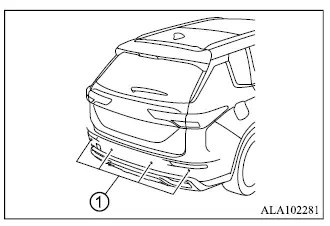
Observe the following maintenance precautions to help ensure proper operation of the Rear AEB system on the Mitsubishi Outlander:
- Always keep sensors 1 clean and free from material that could interfere with obstacle detection.
- If the sensors become dirty, carefully wipe them with a soft cloth, taking care not to scratch, strike, or otherwise damage the sensor surfaces.
- The sensors may be temporarily obstructed by surrounding conditions such as splashing water, mist, or fog. Detection can also be affected by ice, water droplets, frost, dirt, or other material covering the sensors. Inspect the sensor areas regularly and remove any obstruction that could interfere with proper operation.
- Do not subject the area surrounding sensors 1 to strong impacts. Do not remove, disassemble, or modify the sensors. If the sensors or surrounding bumper areas become deformed or damaged in an accident or other impact, have them inspected. It is recommended that you visit an authorized Mitsubishi Motors dealer for this service.
- Do not attach stickers, including transparent stickers, install accessories, or apply additional paint to sensors 1 or the surrounding areas. These materials may interfere with sensor operation and could cause improper Rear AEB performance or a system malfunction.
- When washing the Mitsubishi Outlander with a high-pressure washer, do not direct the high-pressure water jet at the sensors. Excessive water pressure may damage the sensors or cause them to malfunction.
