
Head restraints are an important part of the Mitsubishi Outlander occupant protection system. When correctly installed and positioned, they can help support the head and reduce the risk of certain neck injuries, particularly in some rear-end collisions.
WARNING
- Head restraints supplement the other safety systems in the vehicle and may provide additional protection against injury in certain rear-end collisions. Adjustable head restraints must be positioned correctly as described in this section. Check the adjustment whenever another person has used the seat, because the restraint may have been moved. Do not attach objects to the head restraint stalks, and do not operate the vehicle with a head restraint removed from an occupied seat. If a restraint has been taken out, reinstall it in the correct seating position and make sure it is properly adjusted and securely locked before anyone uses the seat. Failure to follow these instructions can reduce the effectiveness of the head restraint and increase the risk of serious injury or death in a collision.
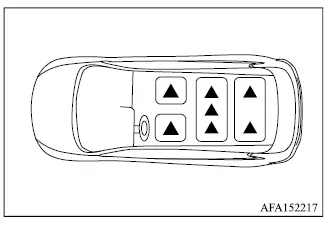
This symbol indicates that the corresponding seating position is equipped with a head restraint.
- The Mitsubishi Outlander is equipped with head restraints that may be integrated into the seat, adjustable or non-adjustable, depending on the seating position.
- Adjustable head restraints have several notches along the stalks, allowing the restraint to lock securely at different height positions.
- Non-adjustable head restraints use a single locking notch that secures the restraint to the seat frame in its intended position.
- The head restraints fitted to the second row and third row seats are non-adjustable types.
- Proper adjustment:
- For an adjustable head restraint, raise or lower it so that the center of the restraint is approximately level with the center of the occupant's ears. This position provides more effective support for the head.
- If the occupant's ears remain above the recommended alignment even after adjustment, place the head restraint in its highest available position.
- If a head restraint has been removed for folding a seat or carrying cargo, reinstall it in the correct seat and confirm that it is fully locked before the seating position is used again.
Adjustable head restraint components
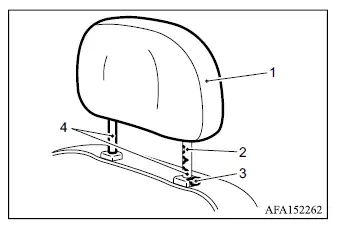
The adjustable head restraint assembly uses locking notches in the stalks to hold the restraint at the selected height. The lock knob must engage correctly before the seat is occupied.
- Removable head restraint that supports the occupant's head when correctly positioned.
- Multiple adjustment notches used to secure the restraint at different heights.
- Lock knob that releases or secures the head restraint during adjustment and removal.
- Stalks that connect the head restraint to the seatback.
Non-adjustable head restraint components
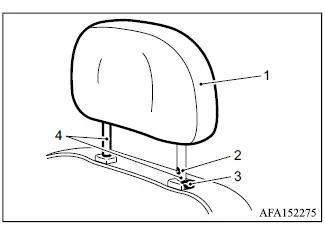
A non-adjustable head restraint is installed at a fixed operating height and uses a single notch to lock it securely into the seatback. Although its height cannot be changed, it must still be correctly installed before the seat is used.
- Removable head restraint designed for the specified seating position.
- Single notch that locks the restraint into its installed position.
- Lock knob used when releasing or reinstalling the head restraint.
- Stalks that fit into the head restraint guides in the seatback.
Remove
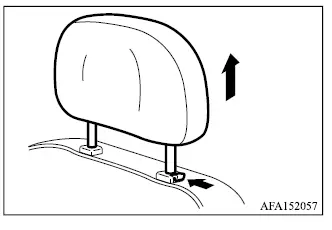
Use the following procedure to remove the head restraint from the Mitsubishi Outlander seat. Support the restraint with both hands during removal, and avoid forcing the stalks if they do not move freely.
1. Pull the head restraint upward until it reaches its highest position.
2. Press and hold the lock knob to release the head restraint stalk.
3. While holding the lock knob, lift the head restraint completely out of the seatback.
4. Store the removed head restraint securely so it cannot move freely inside the Mitsubishi Outlander during driving, braking or a collision.
5. Reinstall the head restraint in the correct seating position and adjust it properly before allowing an occupant to use the seat.
Install
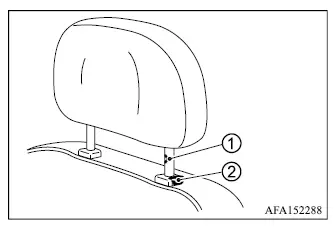
1. Align the head restraint stalks with the guide holes in the top of the seatback. Confirm that the head restraint is facing the correct direction before inserting it.
The stalk with adjustment notch 1 must be inserted into the guide hole equipped with lock knob 2. Correct alignment is necessary for the locking mechanism to operate properly.
2. Press and hold the lock knob, then push the head restraint downward into the seatback guides.
3. Adjust the head restraint to the correct position and confirm that it is securely locked before an occupant uses the seat.
Adjust
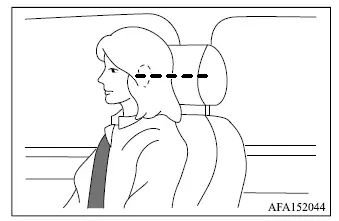
For adjustable head restraint
Position the head restraint so its center is approximately level with the center of the occupant's ears. This alignment helps the restraint support the head more effectively. If the occupant's ears remain above the center of the restraint, raise it to the highest available locking position.
For non-adjustable head restraint
Before the designated seat is occupied, make sure the head restraint is fully inserted and that the lock knob is engaged in the locking notch. The restraint must remain securely fixed in its intended operating position.
Raise
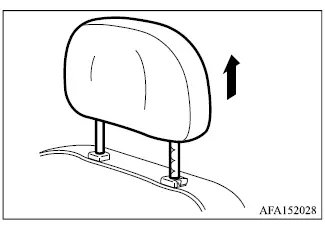
To raise the head restraint, pull it straight upward until it reaches the required height.
Before using the seat, make sure the head restraint remains at the selected height and that the lock knob has engaged securely in one of the adjustment notches.
Lower
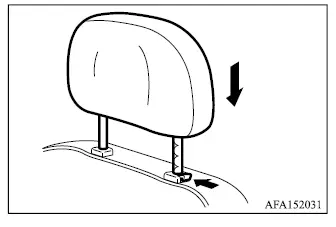
To lower the head restraint, press and hold the lock knob while pushing the restraint downward to the desired position.
Release the lock knob and check that it engages in the appropriate notch before an occupant uses the seating position. A head restraint that is not securely locked may not provide its intended support.
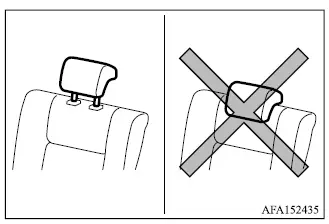
WARNING
- When a passenger occupies the second row center seating position, raise the head restraint until it locks securely at an appropriate height. Complete this adjustment before the Mitsubishi Outlander begins moving. Leaving the center head restraint lowered or unlocked may increase the risk of serious injury in a collision.
