
This section explains important safety information about the Supplemental Restraint System fitted to the Mitsubishi Outlander, including the airbags and seat belt pretensioners designed to provide additional occupant protection in certain collisions.
- Driver and front passenger SRS airbags, also referred to as the Advanced Airbag System.
- Driver and front passenger SRS knee airbags.
- Front seat-mounted SRS side airbags.
- Second-row outboard seat-mounted SRS side airbags.
- Front seat-mounted SRS center airbag.
- Side Curtain SRS airbags.
- Seat belt pretensioners for the front seats and second-row outboard seating positions.
Driver and front passenger SRS airbag system: The Mitsubishi Outlander Advanced Airbag System is designed to help cushion impact forces applied to the head and chest of the driver and front passenger during certain frontal collisions.
Driver and passenger SRS knee airbag system: The driver's and front passenger's SRS knee airbags supplement the primary protection provided by the seat belts. During certain moderate to severe frontal collisions, they can help limit forward movement of the lower legs and contribute to more effective overall occupant protection.
Front seat-mounted SRS side airbag system: This system is designed to help cushion impact forces applied to the chest and pelvic area of the driver and front passenger during certain side-impact collisions.
The applicable side airbag is designed to inflate on the side of the Mitsubishi Outlander that receives the impact.
Second-row outboard seat-mounted SRS side airbag system: This system can help reduce impact forces applied to the chest area of passengers occupying the second-row outboard seats during certain side-impact collisions. The second-row side airbag is designed to inflate on the side where the vehicle is struck.
Front seat-mounted SRS center airbag system: This system is designed to help cushion impact forces affecting the head area of the driver and front passenger during certain side-impact collisions.
The center airbag may inflate when either the left or right side of the vehicle is involved in an applicable impact.
Side Curtain SRS airbag system: The curtain airbag system can help cushion impact forces applied to the heads of occupants in the front and second-row outboard seating positions during certain side-impact or rollover collisions. The curtain airbags are also designed to help reduce the risk of an occupant being completely or partially ejected through a side window during these types of accidents.
During a qualifying side impact, the curtain airbag is designed to inflate on the side where the Mitsubishi Outlander is struck. During a rollover, the curtain airbags on both sides are designed to deploy. In either situation, the curtain airbags remain inflated for a short period to provide continued supplemental protection.
These Supplemental Restraint System components are designed to work together with the seat belts used by the driver, front passenger and second-row outboard passengers. They do not replace the protection provided by correctly fastened seat belts. Every occupant must wear a seat belt properly and sit at a suitable distance from the steering wheel, instrument panel and door trim.
The airbags can operate only when the ignition switch is in the ON or START position.
When the ignition is placed in the ON position, the SRS airbag warning light illuminates as the system performs an operating check.
If the SRS components are functioning normally, the warning light turns off after approximately 7 seconds.
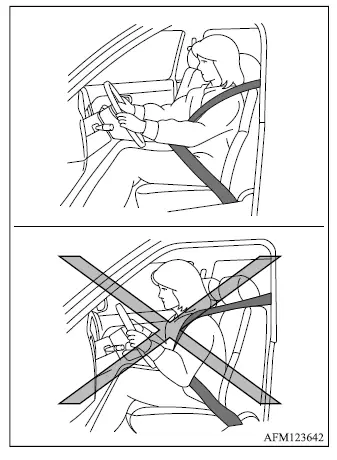
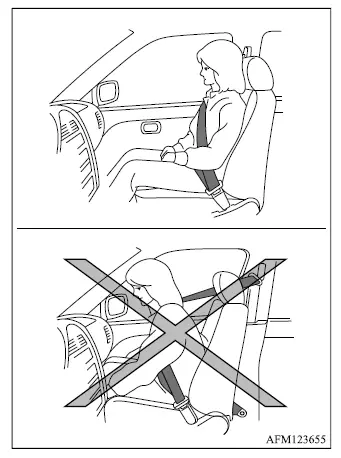
WARNING
- IT IS ESSENTIAL TO WEAR YOUR SEAT BELT CORRECTLY AT ALL TIMES, EVEN WHEN THE SEATING POSITION IS PROTECTED BY AN AIRBAG.
- Seat belts help keep the driver and passengers correctly positioned in their seats. Proper restraint reduces the risk of injury in all types of collisions and lowers the likelihood of serious injury or death when an airbag inflates. During sudden braking immediately before an impact, an unrestrained or incorrectly restrained driver or front passenger may move forward and come into direct contact with, or move dangerously close to, an airbag as it begins to deploy.
The initial stage of airbag inflation produces the greatest force. An occupant who is too close to the airbag or comes into contact with it as deployment begins may suffer serious or fatal injuries.
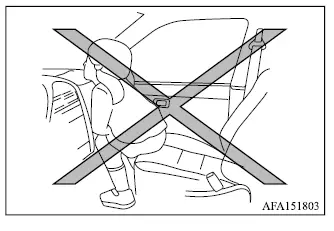
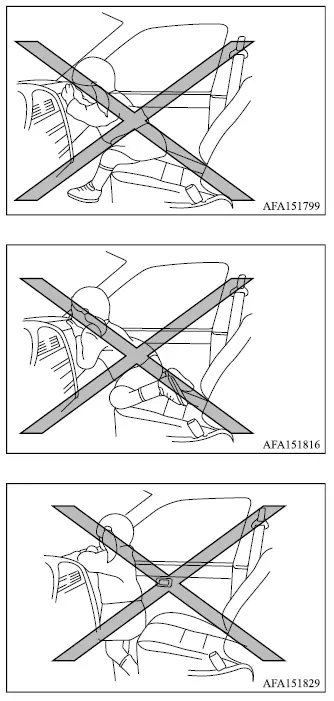
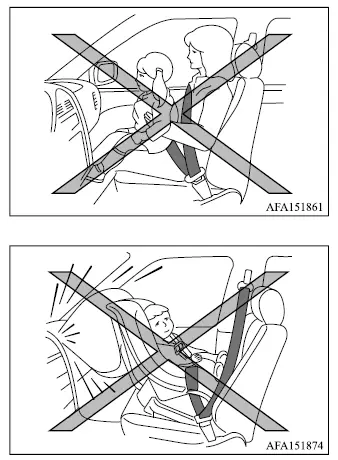
WARNING
- Never allow children to ride without proper restraints or to extend their hands, arms or face through an open window.
Do not attempt to protect a child by holding the child on your lap or in your arms. An adult cannot safely restrain a child against the forces produced during sudden braking or a collision. The illustrations show examples of dangerous riding positions.
- Children who are not properly restrained may be seriously injured or killed when a front, side or curtain airbag inflates. Pre-teens and younger children should ride in an appropriate child restraint or seat belt in a rear seating position whenever possible.
- Even with the Advanced Airbag System, never install a rear-facing child restraint or infant restraint on the front passenger seat. A deploying front passenger airbag could strike the restraint with considerable force and seriously injure or kill the child.
Do not lean against doors or windows.
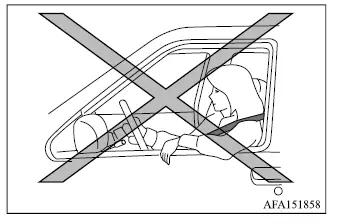
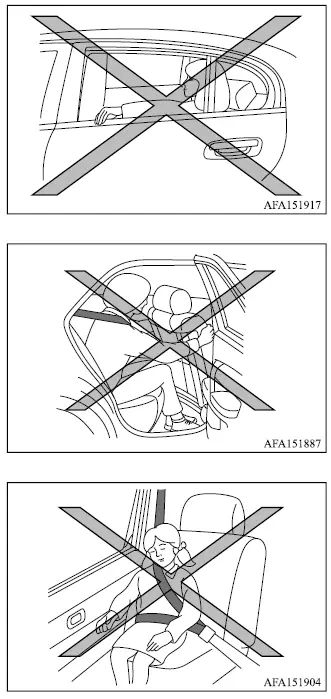
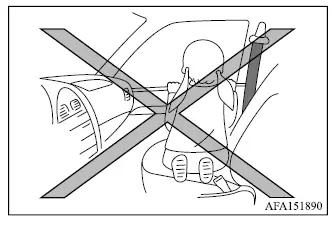
WARNING
- Front and second row seat-mounted side airbags and Side Curtain SRS airbags:
- The seat-mounted side airbags will not normally inflate during a frontal impact, rear impact, rollover or lower-severity side collision. Always wear the seat belt correctly because it provides essential protection in accidents where the side airbags are not designed to deploy.
- The curtain airbags will not normally inflate during a frontal impact, rear impact or lower-severity side collision.
Every occupant must remain properly restrained to help reduce the likelihood and severity of injury in the many types of accidents where curtain airbag deployment may not occur.
- The seat belts, seat-mounted side airbags and curtain airbags provide their most effective protection when occupants sit upright and fully back against the seatbacks. These airbags inflate with considerable force. Do not allow anyone to place a hand, arm, leg or face near the side airbag area on the outer side of a front or second-row seatback, or near the roof rails where the curtain airbags are stored. Occupants in the front seats and second-row outboard seats must not extend their hands or arms through an open window or lean against a door. Anyone positioned too close to a deploying side or curtain airbag may suffer serious or fatal injuries. The preceding illustrations show examples of unsafe seating positions.
- Do not attach stickers, labels, accessories or additional trim to the back or outer side of either front seat.
Added material may cover the airbag deployment area or interfere with the correct opening of the seat-mounted side airbag.
- Passengers seated in the rear must not hold onto or wrap their arms around the front seatback. Deployment of the front seat-mounted center airbag or either side airbag could cause serious injury to hands, arms or the upper body. Children require particular attention and must remain properly restrained in an appropriate seating position.
- Do not install seat covers, upholstery accessories or other coverings over the front or second-row seatbacks unless they are specifically approved for use with the vehicle's airbag system. An unsuitable cover may restrict or redirect side airbag inflation.
- Do not allow a child to lean against or sit close to a passenger door, even when the child is secured in a child restraint system.
The child's head must not rest against or remain close to the side of the seatback or roof area where the seat-mounted side airbag and curtain airbag deploy. Airbag inflation in this position can expose the child to substantial force.
Failure to maintain a safe seating position and follow these instructions may result in serious injury or death to the child.

The illustration identifies the principal Mitsubishi Outlander Supplemental Restraint System components distributed throughout the passenger compartment and body structure. These modules, sensors and pretensioners work together to monitor applicable collision conditions and operate the relevant restraint equipment when required.
- Driver and front passenger SRS airbag modules located in the steering wheel and instrument panel.
- Front passenger occupant classification sensors, also referred to as weight sensors.
- Front seat-mounted SRS side airbag modules.
- Side Curtain SRS airbag modules positioned along the sides of the roof.
- Second-row outboard seat-mounted SRS side airbag modules.
- Crash zone sensor used by the Supplemental Restraint System.
- Driver and front passenger SRS knee airbag modules.
- Airbag Control Unit [ACU], which monitors and controls applicable SRS functions.
- Front door pressure sensors, with the left side shown and the right side arranged similarly.
- Front seat-mounted SRS center airbag module.
- Lap outer seat belt pretensioners, with the left side shown and the right side similar.
- Front seat belt pretensioners, with the left side shown and the right side arranged similarly.
- Side-impact sensors, with the left side shown and the right side similar.
- Second-row outboard seat belt pretensioners, with the left side shown and the right side arranged similarly.
