
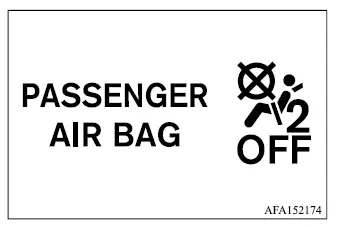
Front passenger airbag status light (except for Puerto Rico)
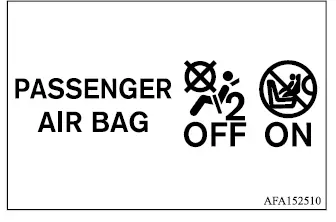
Front passenger airbag status light (for Puerto Rico)
WARNING
- The front passenger airbag and passenger knee airbag are designed to switch off automatically under certain conditions. Read this section carefully so you understand how the occupant classification system and status light operate.
Correct use of the front passenger seat, seat belt and child restraint system is essential for effective occupant protection. Failure to follow the instructions in this manual regarding seats, seat belts and child restraints may increase the likelihood or severity of injury in a collision.
- On Mitsubishi Outlander models except those for Puerto Rico, the front passenger airbag status light may illuminate and turn off as the system evaluates the front passenger seating condition.
- On models for Puerto Rico, either the front passenger airbag OFF light or ON light illuminates according to the condition detected at the front passenger seat.
- Do not install an accessory, decoration or other object near the front passenger airbag status light if it could obstruct the driver's view of the indicator. The light must remain clearly visible so the operating status of the front passenger airbag system can be checked.
Status light (except for Puerto Rico)
The Mitsubishi Outlander front passenger seat is equipped with occupant classification sensors, also called weight sensors. These sensors evaluate the weight and pressure applied to the seat and use that information to determine whether the front passenger airbag and passenger knee airbag should be enabled or switched off.
The operating status of the front passenger airbag and passenger knee airbag is shown by the front passenger airbag status light
 located near the inside rearview mirror. After the ignition switch is placed in the ON position, the indicator illuminates for approximately 7 seconds as part of the initial system check. It then turns off or remains illuminated according to the condition detected at the front passenger seat. The light operates as follows:

Objects placed on the front passenger seat may also affect operation of the indicator. Depending on their weight, position and the pressure they apply to the seat cushion, the occupant classification sensors may respond as though the seat is occupied.
For more information about expected system behavior and conditions that may affect sensor readings, refer to "Normal operation" and "Troubleshooting" in this section.
Status light (for Puerto Rico)
The front passenger seat on Mitsubishi Outlander models for Puerto Rico also uses occupant classification sensors, or weight sensors, to determine whether the front passenger airbag and passenger knee airbag should be turned on or off according to the condition detected on the seat.
The operating status of the front passenger airbag and passenger knee airbag is indicated by the front passenger airbag status lights
 or
or
 located near the inside rearview mirror. When the ignition is switched to the ON position, the front passenger airbag OFF light
 and the front passenger airbag ON light
 should illuminate together for approximately 7 seconds while the system performs its initial check. After this period, the appropriate indicator remains illuminated according to the condition detected at the front passenger seat. The lights operate as follows:
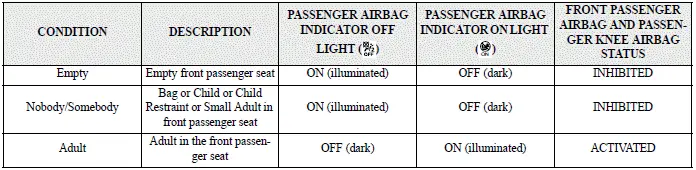
In addition to the conditions shown above, certain objects placed on the front passenger seat may affect the status lights. Depending on the object's weight, position and the pressure it applies to the seat cushion, the occupant classification system may detect the seat as occupied.
For further information about expected system behavior and conditions that may affect the occupant classification sensors, refer to "Normal operation" and "Troubleshooting" in this section.
Front passenger airbag
The Mitsubishi Outlander front passenger airbag is designed to switch off automatically under certain operating conditions permitted by U.S. regulations. When the front passenger airbag is turned off, it will not deploy during a collision. The driver's airbag and the other airbags installed in the vehicle are not controlled by this part of the occupant classification system.
The purpose of these regulations is to reduce the risk of serious or fatal injury that an inflating front passenger airbag could cause to certain occupants, particularly children, by requiring the system to deactivate the airbag automatically when specified conditions are detected.
The occupant classification sensors, also known as weight sensors, are installed in the seat cushion frame beneath the front passenger seat. They are designed to detect the presence and weight distribution of an occupant or object placed on the seat.
For example, when a child occupies the front passenger seat, the Advanced Airbag System is designed to switch off the passenger airbag in accordance with applicable regulations. The sensors may also recognize certain types of child restraint placed on the seat and cause the front passenger airbag and passenger knee airbag to remain off.
An adult occupant who sits upright, remains centered on the front passenger seat and wears the seat belt correctly as described in this manual should not normally cause the front passenger airbag and passenger knee airbag to switch off automatically. The airbags may be turned off for a smaller adult, however, if the person is not seated correctly, such as sitting on the edge of the cushion, leaning away from the seatback or otherwise placing body weight unevenly on the seat.
For the most effective protection from both the seat belt and airbag system, the front passenger should sit upright and fully back against the seatback, keep both feet on the floor and wear the seat belt correctly.
Mitsubishi Motors recommends that pre-teens and children travel properly restrained in a rear seating position. Suitable child restraints and booster seats should also be installed in the rear whenever possible. If a child restraint must be placed on the front passenger seat, the occupant classification sensors are designed to operate as described above for specified restraint types.
A child restraint that is not installed securely, or a restraint installed without activating Automatic Locking Retractor [ALR] mode when required, may tip or move during sudden braking or a collision. Incorrect installation may also cause the system to classify the seat improperly, allowing the front passenger airbag and passenger knee airbag to deploy instead of remaining off.
If the front passenger seat is unoccupied, the front passenger airbag and passenger knee airbag are designed not to deploy in a collision. A heavy object placed on the seat may nevertheless be detected by the occupant classification sensors and could cause the airbags to remain enabled.
Other improper seating conditions may also affect airbag operation. Examples include a child standing on the seat or two children sharing the same seating position. These situations are contrary to the instructions in this manual. Every Mitsubishi Outlander occupant must use an individual seating position and the appropriate restraint system.
The front passenger airbag status light allows the driver to check whether the front passenger airbag and passenger knee airbag have been switched off automatically.
If an adult is seated in the front passenger position while the status light indicates that the front passenger airbag and passenger knee airbag are off, the occupant may be a smaller adult or may not be sitting correctly on the seat. The passenger should reposition themselves upright and centered on the cushion, place both feet on the floor and refasten the seat belt correctly before the airbag status is checked again.
If a child restraint must be installed on the front passenger seat, the front passenger airbag status light may illuminate or remain off depending on the child's size, the type of restraint and how the system classifies the seating condition. If the status light does not illuminate, indicating that the front passenger airbag may be active in a collision, the child restraint, seat belt or occupant position may be incorrect. Confirm that the restraint is installed exactly as instructed, the seat belt is routed and fastened properly, and the child is positioned correctly. If the status light still does not illuminate, move the child restraint or occupant to a suitable rear seating position.
If the front passenger airbag status light remains off even though the child restraint, seat belt and occupant appear to be positioned correctly, Mitsubishi Motors recommends having the Mitsubishi Outlander inspected by an authorized Mitsubishi Motors dealer. The dealer can evaluate the occupant classification and airbag system with specialized diagnostic equipment. Until the system has been confirmed to operate correctly, place the child restraint or affected occupant in an appropriate rear seat.
The Advanced Airbag System and front passenger airbag status light may require several seconds to recognize and display a change in the front passenger seat condition. This brief delay is part of normal operation and does not by itself indicate a malfunction.
If the front passenger airbag system develops a fault, the SRS airbag warning light
 , located in the meters and gauges area, will illuminate. Have the system inspected promptly. Mitsubishi Motors recommends visiting an authorized Mitsubishi Motors dealer for this service.
Normal operation
For the occupant classification sensor system to evaluate the front passenger accurately based on detected weight and seating position, follow the precautions and procedure below before driving the Mitsubishi Outlander.
Precautions
- Make sure no objects with a combined weight greater than 9.1 lb (4 kg) are hanging from the front passenger seat, head restraint or stored in the seatback pockets.
- Confirm that a child restraint, package or other object is not pressing against the rear of the front passenger seatback.
- Do not allow a rear passenger to push, pull or rest their feet against the back of the front passenger seat.
- Make sure the front passenger seat or seatback is not forced against luggage, a child restraint or another object positioned on the rear seat or floor behind it.
- Keep the area beneath the front passenger seat completely free of objects that could contact the seat frame or affect the sensors.
- When adjusting the front passenger seat, make sure the head restraint does not press against the roof or otherwise prevent the seat from reaching its intended position.
Steps
1. Adjust the front passenger seat as described in this manual.
Sit upright and centered on the seat cushion with the back resting firmly against the seatback. Place both feet comfortably on the floor and avoid leaning toward the door, center console or instrument panel.
2. Remove all objects from the passenger's lap, including bags, electronic devices or other items that could affect weight distribution.
3. Fasten the seat belt correctly as described in the "Seat belts" section.
The front passenger seat belt buckle status is monitored by the occupant classification system and is used as one of the inputs when determining occupancy status. The front passenger should therefore keep the seat belt properly fastened whenever the vehicle is moving.
4. Remain seated in this position for approximately 30 seconds so the system can classify the front passenger before the vehicle begins moving.
5. Check the front passenger airbag status light to confirm that the occupant has been classified as expected.
NOTE
- The Mitsubishi Outlander occupant classification sensor system generally locks the classification while the vehicle is being driven, making it important to verify the front passenger airbag status before departure. Under certain conditions, the system may recalculate the occupant's weight while the vehicle is moving or stopped. The front passenger should therefore remain upright, centered on the seat and correctly restrained throughout the journey.
Troubleshooting
If the front passenger airbag status light appears to show an incorrect condition, use the following troubleshooting procedure.
1. If the status light is ON while an adult is occupying the front passenger seat:
- If the occupant is a small adult, the front passenger airbag status light may be operating as intended. In this condition, the front passenger airbag and passenger knee airbag are suppressed.
If the occupant is not a small adult, one or more of the following conditions may be affecting the occupant classification sensors:
- The occupant is not sitting upright, centered on the seat cushion and fully against the seatback with both feet comfortably placed on the floor.
- A child restraint, package or another object is pressing against the rear of the front passenger seatback.
- A rear passenger is pushing, pulling or applying pressure to the back of the front passenger seat.
- The front passenger seat or seatback is being forced against an object on the rear seat or floor behind it.
- An object is positioned beneath the front passenger seat and is contacting the seat frame or sensor area.
- An item is wedged between the seat cushion and the center console, or between the seat cushion and the passenger door.
If the Mitsubishi Outlander is moving, stop in a safe location before making any adjustments. Correct any condition listed above, restart the vehicle and wait approximately 1 minute for the system to evaluate the front passenger seat again.
NOTE
- During the initial system check, the front passenger airbag status light will remain illuminated for approximately 7 seconds before displaying the detected passenger-seat condition.
If the status light remains ON after the checks and reset procedure, the adult occupant should not use the front passenger seat. Mitsubishi Motors recommends having the Advanced Airbag System inspected by an authorized Mitsubishi Motors dealer as soon as possible.
2. If the status light is OFF while a small adult, child or child restraint is occupying the front passenger seat:
One or more of the following conditions may be interfering with the occupant classification sensors:
- The small adult or child is not sitting upright, centered on the seat cushion and fully against the seatback with both feet comfortably positioned on the floor.
- The child restraint has not been installed or secured correctly according to the applicable instructions.
- An object weighing more than 9.1 lb (4 kg) is hanging from the seat or stored in the seatback pockets.
- A child restraint or another object is pressing against the rear of the front passenger seatback.
- A rear passenger is pushing, pulling or leaning against the back of the front passenger seat.
- The front passenger seat or seatback is being forced against an object on the seat or floor behind it.
- An object has been placed beneath the front passenger seat.
- An item is positioned between the seat cushion and the center console.
- The front passenger seat head restraint is contacting the roof and preventing the seat from remaining in its intended position.
If the vehicle is moving, stop as soon as it is safe to do so. Inspect the front passenger seating area, correct any of the conditions listed above, restart the Mitsubishi Outlander and wait approximately 1 minute for the occupant classification system to reassess the seat.
NOTE
- The system performs an initial check after the vehicle is restarted. During this check, the front passenger airbag status light remains illuminated for approximately 7 seconds.
If the status light remains OFF after completing these checks, move the small adult, child or child restraint to a suitable rear seating position. Mitsubishi Motors recommends having the vehicle inspected by an authorized Mitsubishi Motors dealer as soon as possible.
