
When towing the Mitsubishi Outlander, always comply with all applicable local, regional, and jurisdictional towing regulations.
Using incorrect towing equipment or procedures can damage the vehicle. Detailed towing instructions are available from an authorized Mitsubishi Motors dealer. Professional towing and roadside service operators are generally familiar with the applicable legal requirements and proper recovery procedures. To help ensure safe transport and prevent accidental damage to the Mitsubishi Outlander, Mitsubishi Motors recommends having the vehicle towed by a qualified service operator. The operator should also review the precautions described below before towing begins.
WARNING
- Never ride inside the Mitsubishi Outlander while it is being towed.
- Never crawl or position yourself underneath the vehicle after it has been raised by a tow truck or other towing equipment.
CAUTION
- Before towing, make sure the transmission, axles, steering system, and powertrain are in suitable operating condition. If any of these components are damaged, inoperative, or otherwise unable to function normally, towing dollies or a flatbed tow truck must be used.
- Always attach appropriate safety chains before the Mitsubishi Outlander is towed.
NOTE
- If the battery is completely discharged, the transmission cannot be manually shifted into another position. To restore the ability to shift, charge the battery or provide electrical power by following the jump-starting procedure. Push the park button to place the transmission in P (Park) before attempting to shift to another position.
Towing recommended by Mitsubishi Motors
All-Wheel Control (AWC) models
All-Wheel Control models
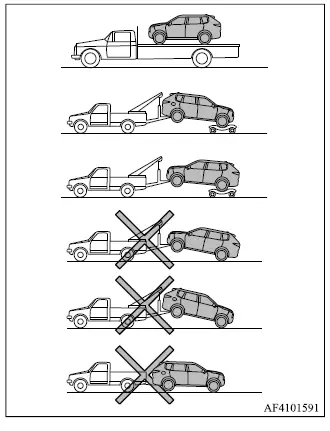
For All-Wheel Control (AWC) models, Mitsubishi Motors recommends using towing dollies or transporting the Mitsubishi Outlander completely on a flatbed truck, as shown in the illustration.
CAUTION
- Never tow an AWC model with any of its wheels remaining on the ground. Doing so can cause serious and costly damage to the powertrain.
Front-Wheel Drive (FWD) models
Front-wheel drive models
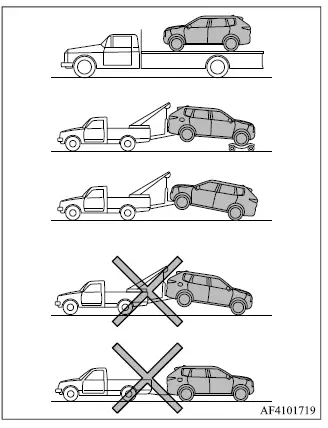
For Front-Wheel Drive (FWD) models, Mitsubishi Motors recommends towing the vehicle with the driven front wheels raised clear of the ground or transporting the entire vehicle on a flatbed truck, as illustrated.
NOTE
- If the electric parking brake has been released, the rear wheels may remain on the ground during towing. If the electric parking brake cannot be released, towing dollies should be placed under the rear wheels.
CAUTION
- Never tow a CVT-equipped Mitsubishi Outlander with the front wheels on the ground or with all four wheels on the ground, whether the vehicle is being moved forward or backward. Doing so can cause serious and costly transmission damage. If the vehicle must be towed with the rear wheels raised, always place towing dollies under the front wheels.
Vehicle recovery (freeing a stuck vehicle)
WARNING
- To reduce the risk of vehicle damage, serious personal injury, or death while recovering a stuck vehicle:
- Contact a professional towing or recovery service if you are uncertain about the correct procedure or attachment points.
- Attach tow chains, straps, or cables only to suitable main structural members of the Mitsubishi Outlander.
- Do not use the vehicle tie-down points for towing or for pulling a stuck vehicle free.
- Use only recovery equipment specifically designed for this purpose, and always follow the equipment manufacturer's instructions and safety precautions.
- Apply the recovery force straight from the front of the vehicle. Never pull the Mitsubishi Outlander at an angle, as this can increase the risk of damage or loss of control.
- Position recovery straps, cables, or other devices so they do not contact any part of the vehicle other than the designated attachment point.
If the Mitsubishi Outlander becomes stuck in sand, snow, mud, or similar conditions, use a tow strap or another recovery device specifically designed for freeing vehicles. Follow all instructions supplied by the recovery equipment manufacturer and use only appropriate attachment points.
Rocking a stuck vehicle
WARNING
- Keep all people well clear of the Mitsubishi Outlander while attempting to free it from sand, snow, mud, or another soft surface.
- Do not spin the tires at high speed. Excessive wheel speed can cause a tire to fail or burst and may result in serious injury. High-speed wheel spin can also overheat and damage vehicle components.
If the Mitsubishi Outlander is stuck in sand, snow, mud, or similar conditions, use the following procedure:
1. Turn off the Active stability control [ASC].
2. Check the area in front of and behind the vehicle and make sure it is clear of people, obstacles, and other hazards.
3. Turn the steering wheel from side to side to help clear space around the front tires and improve their ability to move.
4. Slowly rock the vehicle forward and backward to build enough momentum to free it.
- Shift alternately between R (Reverse) and D (Drive).
- Use as little accelerator input as necessary to maintain a controlled rocking motion.
- Release the accelerator pedal before shifting between R (Reverse) and D (Drive).
- Do not allow the tires to spin at speeds above 35 MPH (55 km/h).
5. If the Mitsubishi Outlander cannot be freed after several controlled attempts, stop the procedure and contact a professional towing or vehicle recovery service.
