
CAUTION
- Keep the battery and all removed transmitter components out of the reach of children to prevent accidental swallowing.
- Improper battery disposal can harm the environment. Always follow applicable local regulations for recycling or disposing of used batteries.
- When replacing the transmitter battery, take care not to allow dust, oil, moisture, or other contaminants to contact the internal components.
- There is a risk of explosion if the lithium battery is installed incorrectly or replaced with an unsuitable type. Use only the same battery type or an equivalent replacement.
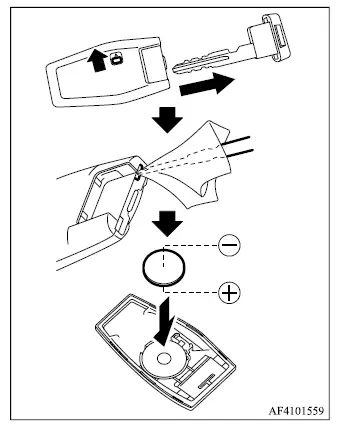
Replace the battery in the Mitsubishi Outlander transmitter using the following procedure:
1. Remove the emergency key from the transmitter.
2. Insert a small screwdriver into the slit at the corner of the transmitter case and gently twist it to separate the upper and lower sections. Place a soft cloth between the screwdriver and the case to help prevent scratches or damage.
3. Remove the old battery and install a new one.
Recommended battery: CR2032 or equivalent
- Do not touch the internal electronic circuit or electrical terminals, as contamination or static discharge could cause the transmitter to malfunction.
- Hold the replacement battery only by its edges. Touching both battery contact surfaces can significantly reduce its available charge.
- Make sure the (+) side of the battery faces the bottom of the transmitter case.
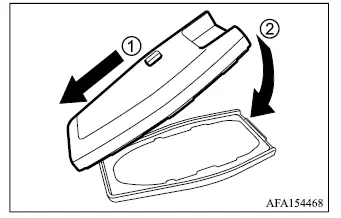
4. Align the ends of upper and lower sections 1, then press the two sections together in direction 2 until the transmitter case closes securely.
5. Operate the transmitter buttons and confirm that all functions work correctly after the battery has been replaced.
If assistance is required with transmitter battery replacement, it is recommended that you visit an authorized Mitsubishi Motors dealer for this service.
FCC Notice:
For USA:
FCC ID: KR5MTXN1
FCC ID: KR5HFM401
This device complies with Part 15 of the FCC Rules. Operation is subject to the following two conditions: (1) this device may not cause harmful interference, and (2) this device must accept any interference received, including interference that may cause undesired operation.
CAUTION
- Changes or modifications not expressly approved by the party responsible for regulatory compliance could void the user's authority to operate this equipment.
For Canada:
IC: 7812D-MTXN1
IC: 7812D-HFM401
This device complies with Industry Canada licence-exempt RSS standard(s).
Operation is subject to the following two conditions: (1) this device may not cause interference, and (2) this device must accept any interference, including interference that may cause undesired operation of the device.
Le présent appareil est conforme aux CNR d'Industrie Canada applicables aux appareils radio exempts de licence. L'exploitation est autorisée aux deux conditions suivantes : (1) l'appareil ne doit pas produire de brouillage, et (2) l'utilisateur de l'appareil doit accepter tout brouillage radioélectrique subi, même si le brouillage est susceptible d'en compromettre le fonctionnement.
