
WARNING
- Riding in a cargo area inside the Mitsubishi Outlander is extremely dangerous. In a collision or sudden stop, anyone occupying these areas is far more likely to suffer serious or fatal injuries.
- Never allow passengers to ride in any part of the vehicle that is not equipped with an approved seat and seat belt.
- Make sure every occupant of the Mitsubishi Outlander is properly seated and correctly restrained with a seat belt whenever the vehicle is in motion.
Terms
Before loading the Mitsubishi Outlander with passengers, luggage, or other cargo, become familiar with the following terms and weight definitions:
- Vehicle maximum load on the tire: the load carried by an individual tire, calculated by distributing each axle's share of the maximum loaded vehicle weight and then dividing that axle load by two.
- Vehicle normal load on the tire: the load carried by an individual tire, determined by distributing each axle's share of the curb weight, accessory weight, and normal occupant weight, and then dividing that amount by two.
- Maximum loaded vehicle weight:
the total of -
- Curb weight;
- Accessory weight;
- Vehicle capacity weight; and
- Production options weight.
- Curb weight: the weight of the motor vehicle with its standard equipment and with fuel, engine oil, and coolant filled to their maximum specified capacities.
- Accessory weight: the combined weight, above the weight of standard items they may replace, of equipment such as an automatic transaxle, power steering, power brakes, power windows, power seats, radio, and heater, to the extent that these items are available as factory-installed equipment, whether or not they are actually installed on the vehicle.
- Vehicle capacity weight: the rated cargo and luggage load plus 150 lb (68 kg) multiplied by the vehicle's designated seating capacity.
- Production options weight: the combined weight of installed regular-production options weighing more than 5 lb (2.3 kg) above the standard components they replace and not already included in curb weight or accessory weight. Examples include heavy-duty brakes, ride levelers, a roof rack, a heavy-duty battery, and special trim.
- Normal occupant weight: 150 lbs (68 kg) multiplied by the specified number of occupants, which is 3 for this vehicle.
- Occupant distribution: the specified distribution of occupants within the passenger compartment. For the Mitsubishi Outlander covered by this information, the distribution is 2 occupants in the front seats and 1 occupant in the second-row seat.
- GVW (Gross Vehicle Weight) - the curb weight of the vehicle plus the combined weight of all passengers and cargo.
- GVWR (Gross Vehicle Weight Rating) - the maximum permitted combined weight of the unloaded vehicle, passengers, luggage, hitch, trailer tongue load, and any other optional equipment. The GVWR is shown on the F.M.V.S.S./C.M.V.S.S. certification label.
- GAWR (Gross Axle Weight Rating) - the maximum allowable load specified for either the front or rear axle. The applicable GAWR values are listed on the F.M.V.S.S./C.M.V.S.S. certification label.
- GCWR (Gross Combined Weight Rating) - the maximum allowable combined weight of the Mitsubishi Outlander, its passengers, cargo, and any trailer being towed.
- Vehicle Capacity Weight, Load limit, Total load capacity - the maximum combined weight of passengers and cargo that may be carried by the vehicle. If the Mitsubishi Outlander is used to tow a trailer, the trailer tongue weight must be counted as part of the cargo load. This information is shown on the Tire and Loading Information placard.
- Cargo capacity - the maximum permissible cargo weight remaining after the total weight of the occupants has been subtracted from the vehicle load limit.
*: 150 lbs (68 kg) represents the standard weight of one person as defined by U.S. and Canadian regulations.
Vehicle load capacity
Do not exceed the Mitsubishi Outlander load limit shown as "The combined weight of occupants and cargo" on the Tire and Loading Information placard. Also do not carry more occupants than the number listed as "Seating Capacity" on that placard.
To determine "the combined weight of occupants and cargo", add together the weight of the driver and all passengers, then add the total weight of luggage and other cargo. The following illustration provides examples of how to make this calculation.
Steps for determining correct load limit
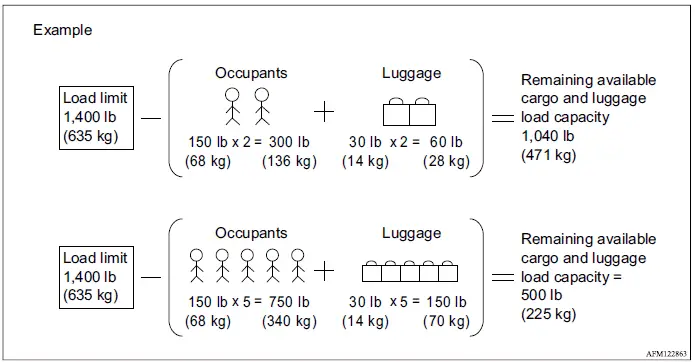
1. Find the statement "The combined weight of occupants and cargo should never exceed XXX lb or XXX kg" on the Tire and Loading Information placard for your Mitsubishi Outlander.
2. Determine the total combined weight of the driver and all passengers who will be traveling in the vehicle.
3. Subtract the combined weight of the driver and passengers from the XXX lb or XXX kg maximum shown on the placard.
4. The remaining amount is the available cargo and luggage load capacity. For example, if the specified maximum is 1,400 lb and five passengers weighing 150 lb each will be riding in the vehicle, the available cargo and luggage capacity is 650 lb. (1,400 − 750 (5 x 150) = 650 lb)
5. Calculate the combined weight of all luggage and cargo to be loaded into or onto the Mitsubishi Outlander. This total must not exceed the available cargo and luggage capacity determined in Step 4.
6. If the vehicle will be used to tow a trailer, part of the trailer load will be transferred to the Mitsubishi Outlander.
Refer to the appropriate towing information in this manual to determine how the trailer load reduces the amount of cargo and luggage that can safely be carried in the vehicle.
Before driving the Mitsubishi Outlander while it is loaded, make sure the Gross Vehicle Weight Rating (GVWR) and Gross Axle Weight Rating (GAWR) are not exceeded. Also verify that all tires are inflated to the specified pressures. Refer to the Tire and Loading Information placard for the applicable values.
Securing the load
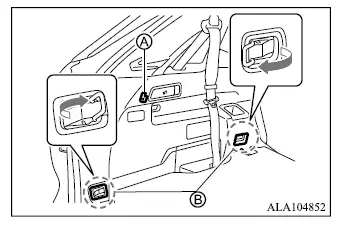
Luggage hooks A and B are installed in the cargo area at the locations shown. These hooks may be used with suitable ropes, straps, or other restraints to help keep cargo from moving while the Mitsubishi Outlander is being driven.
When securing cargo, do not apply a total load greater than 6.6 lb (3 kg) to any single hook A or more than 44 lb (20 kg) to any single hook B.
WARNING
- Secure all cargo properly with suitable ropes, straps, or other restraints to help prevent it from sliding, shifting, or becoming airborne. Do not stack cargo higher than the seatbacks. During sudden braking or a collision, unsecured items can move forward with considerable force and may cause serious injury.
- Make sure cargo in the Mitsubishi Outlander cannot contact or damage a child restraint top tether strap. Secure all items in the cargo area carefully. If a top tether strap is damaged, the child restraint may not provide its intended protection in a collision, increasing the risk of serious or fatal injury.
- Never load the Mitsubishi Outlander beyond its GVWR or the maximum permitted front and rear GAWR values. Excessive loading can damage vehicle components or tires and may adversely affect steering, stability, braking, and overall handling. Loss of vehicle control could result in a collision and personal injury.
Loading tips
- The vehicle's GVW must remain below the GVWR and applicable GAWR limits specified on the F.M.V.S.S./C.M.V.S.S. certification label.
- Do not load both the front and rear axles up to their individual GAWR limits at the same time if doing so would cause the total vehicle weight to exceed the GVWR.
WARNING
- Secure all cargo with appropriate ropes, straps, or other restraints so it cannot slide or shift while the Mitsubishi Outlander is moving. Do not load cargo above the height of the seatbacks. In a sudden stop or collision, unsecured cargo may be thrown forward and cause serious injury.
- Do not exceed the Mitsubishi Outlander GVWR or the maximum front and rear GAWR limits. Overloading can damage vehicle parts or tires and can significantly alter handling and stability. These conditions may lead to loss of control, a collision, and personal injury.
- Overloading can shorten the service life of both the vehicle and its tires. It can also reduce handling stability, increase braking distance, and contribute to premature tire failure. These conditions can increase the risk of a serious accident and injury. Damage or failures resulting from overloading are not covered by the vehicle warranty.
Measurement of weights
Secure all loose items before weighing the Mitsubishi Outlander so that cargo cannot shift and alter the vehicle's balance. With the vehicle loaded as it will be driven, take it to an appropriate scale and measure the front and rear axle loads separately. Neither axle load may exceed its specified Gross Axle Weight Rating (GAWR), and the combined total of the front and rear axle loads must not exceed the Gross Vehicle Weight Rating (GVWR). The applicable ratings are shown on the vehicle certification label. If any weight limit is exceeded, redistribute or remove passengers, luggage, or cargo as necessary until all measured weights are within the specified limits.
WARNING
- Secure all cargo properly with suitable ropes, straps, or other restraints to help prevent it from sliding, shifting, or becoming airborne. Do not stack cargo higher than the seatbacks. During sudden braking or a collision, unsecured items can move forward with considerable force and may cause serious injury.
- Make sure cargo in the Mitsubishi Outlander cannot contact or damage a child restraint top tether strap. Secure all items in the cargo area carefully. If a top tether strap is damaged, the child restraint may not provide its intended protection in a collision, increasing the risk of serious or fatal injury.
- Never load the Mitsubishi Outlander beyond its GVWR or the maximum permitted front and rear GAWR values. Excessive loading can damage vehicle components or tires and may adversely affect steering, stability, braking, and overall handling. Loss of vehicle control could result in a collision and personal injury.
Loading tips
- The vehicle's GVW must remain below the GVWR and applicable GAWR limits specified on the F.M.V.S.S./C.M.V.S.S. certification label.
- Do not load both the front and rear axles up to their individual GAWR limits at the same time if doing so would cause the total vehicle weight to exceed the GVWR.
WARNING
- Secure all cargo with appropriate ropes, straps, or other restraints so it cannot slide or shift while the Mitsubishi Outlander is moving. Do not load cargo above the height of the seatbacks. In a sudden stop or collision, unsecured cargo may be thrown forward and cause serious injury.
- Do not exceed the Mitsubishi Outlander GVWR or the maximum front and rear GAWR limits. Overloading can damage vehicle parts or tires and can significantly alter handling and stability. These conditions may lead to loss of control, a collision, and personal injury.
- Overloading can shorten the service life of both the vehicle and its tires. It can also reduce handling stability, increase braking distance, and contribute to premature tire failure. These conditions can increase the risk of a serious accident and injury. Damage or failures resulting from overloading are not covered by the vehicle warranty.
Measurement of weights
Secure all loose items before weighing the Mitsubishi Outlander so that cargo cannot shift and alter the vehicle's balance. With the vehicle loaded as it will be driven, take it to an appropriate scale and measure the front and rear axle loads separately. Neither axle load may exceed its specified Gross Axle Weight Rating (GAWR), and the combined total of the front and rear axle loads must not exceed the Gross Vehicle Weight Rating (GVWR). The applicable ratings are shown on the vehicle certification label. If any weight limit is exceeded, redistribute or remove passengers, luggage, or cargo as necessary until all measured weights are within the specified limits.
