
WARNING
- Overloading a trailer or distributing its cargo incorrectly can adversely affect Mitsubishi Outlander handling, braking, stability, and overall performance, increasing the risk of a collision.
CAUTION
- Do not tow a trailer or carry a heavy load during the first 500 miles (800 km) of vehicle operation. Doing so could damage the engine, axle, or other drivetrain components before they are properly broken in.
- During the first 500 miles (800 km) of trailer towing, do not exceed 50 MPH (80 km/h) and avoid full-throttle starts. This allows the engine and other vehicle components to adapt gradually to the increased loads associated with towing.
The Mitsubishi Outlander is designed primarily for transporting passengers and cargo under normal driving conditions.
Towing a trailer places additional loads on the engine, drivetrain, steering, braking system, suspension, and other vehicle components. These increased demands should always be considered when planning a trip and loading the vehicle.
Maximum load limits
Maximum trailer loads
Never allow the total trailer load to exceed the value specified in the "Towing load/specification". The total trailer load is the combined weight of the trailer itself and all cargo carried in or on the trailer.
The Gross Combined Weight Rating (GCWR) must not exceed the maximum value shown in the following "Towing Load/Specification" chart.
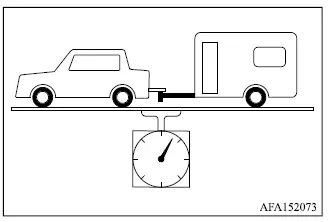
The GCWR is the combined total weight of the towing Mitsubishi Outlander, including its passengers and cargo, plus the complete trailer load. Exceeding the specified towing limits or using unsuitable towing equipment can adversely affect vehicle stability, steering response, braking performance, and overall control.
The Mitsubishi Outlander's practical towing capability depends not only on the maximum permitted trailer load but also on the road and terrain where the vehicle will be operated. A trailer weight that is acceptable for level highway travel may need to be reduced when driving on steep grades or in low-traction conditions, such as slippery boat ramps.
Ambient temperature can also influence towing performance.
For example, towing a heavy trailer in high outside temperatures and on steep or prolonged grades can increase the load on the engine and transmission, reducing performance and potentially causing overheating. The transmission high fluid temperature protection and engine protection mode may activate to help reduce the risk of transmission or engine damage. When this occurs, engine power may be reduced automatically and vehicle speed may decrease under heavy load. Plan the route carefully and consider trailer weight, vehicle load, weather, road grade, and surface conditions before towing.
WARNING
- Overheating may cause engine power and vehicle speed to decrease. The resulting speed may be significantly lower than surrounding traffic, which can increase the risk of a collision.
Drive with particular care under these conditions. If the Mitsubishi Outlander cannot maintain a safe speed, move off the roadway and stop in a safe location. Allow the engine to cool until normal operation can be resumed.
CAUTION
- Damage to the Mitsubishi Outlander resulting from improper trailer towing, incorrect loading, or unsuitable towing procedures is not covered by Mitsubishi Motors warranties.
Tongue load
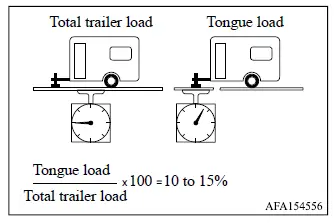
When using either a weight-carrying hitch or a weight-distributing hitch, maintain the trailer tongue load between 10 and 15% of the total trailer load, or use the tongue load specified by the trailer manufacturer. The tongue load must also remain within the maximum limit shown in the "Towing Load/Specification" chart. If the tongue load is too high, redistribute the trailer cargo until the correct load is achieved.
Maximum Gross Vehicle Weight (GVW)/maximum Gross Axle Weight (GAW)
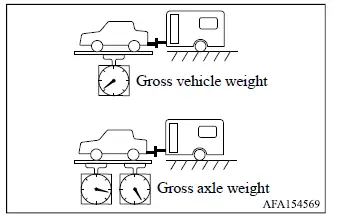
The Gross Vehicle Weight (GVW) of the towing vehicle must never exceed the Gross Vehicle Weight Rating (GVWR) shown on the F.M.V.S.S./C.M.V.S.S. certification label.
GVW is the combined weight of the unloaded Mitsubishi Outlander, all passengers, luggage and cargo, the trailer hitch, trailer tongue load, and any other optional equipment fitted to the vehicle. In addition, the load carried by either the front or rear axle must not exceed the corresponding Gross Axle Weight Rating (GAWR) listed on the F.M.V.S.S./C.M.V.S.S. certification label.
Published towing capacities are calculated using a base vehicle with the driver and any equipment required to achieve the specified rating. Additional passengers, cargo, accessories, and optional equipment, including a trailer hitch, increase the actual vehicle weight and therefore reduce the available towing capacity and allowable trailer tongue load of the Mitsubishi Outlander.
The vehicle and trailer should be weighed to confirm that all applicable limits are respected, including the GVWR, Front GAWR, Rear GAWR, Gross Combined Weight Rating (GCWR), and maximum towing capacity.
Vehicle and trailer weights can be measured using suitable platform scales commonly available at truck stops, highway weigh stations, building supply facilities, or salvage yards.
To determine the available payload capacity for trailer tongue or king pin load, use the following procedure.
1. Locate the GVWR on the F.M.V.S.S./C.M.V.S.S. certification label.
2. Weigh the Mitsubishi Outlander with all passengers, luggage, cargo, and equipment that will normally be carried while towing.
3. Subtract the actual measured vehicle weight from the GVWR. The remaining amount represents the maximum available capacity for tongue or king pin load.
To determine the available towing capacity, use the following procedure.
1. Find the GCWR for your vehicle in the "Towing Load/Specification" chart provided later in this section.
2. Subtract the actual measured vehicle weight from the GCWR. The remaining amount is the maximum available towing capacity under those loading conditions.
To determine Gross Trailer Weight, place the fully loaded trailer on a suitable scale with all equipment, luggage, and cargo that will normally be carried while towing. Make sure the measured Gross Trailer Weight does not exceed the Gross Trailer Weight Rating specified for the trailer and does not exceed the available maximum towing capacity calculated for the Mitsubishi Outlander.
The front and rear axles should also be weighed separately. Confirm that the measured Front Gross Axle Weight and Rear Gross Axle Weight do not exceed the corresponding Front GAWR and Rear GAWR values shown on the F.M.V.S.S./C.M.V.S.S. certification label.
If any vehicle, axle, combined, trailer, or tongue load limit is exceeded, cargo in the Mitsubishi Outlander or trailer may need to be redistributed or removed until all applicable weight ratings are satisfied.
Example:
- Gross Vehicle Weight (GVW) measured on a scale, including passengers, cargo, and hitch - 6,350 lb. (2,880 kg).
- Gross Vehicle Weight Rating (GVWR) from the F.M.V.S.S./C.M.V.S.S. certification label - 7,250 lb. (3,289 kg).
- Gross Combined Weight Rating (GCWR) from the "Towing Load/Specification" chart - 15,100 lb. (6,849 kg).
- Maximum trailer towing capacity from the "Towing Load/Specification" chart - 9,100 lb. (4,128 kg).
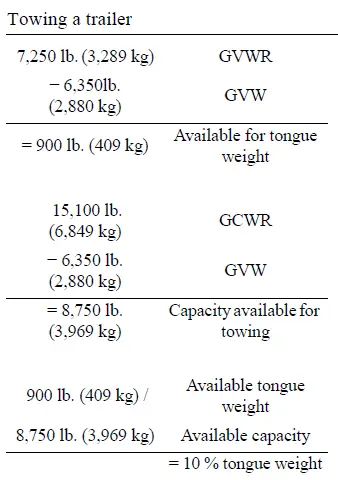
The actual towing capacity available to the Mitsubishi Outlander may be lower than the published maximum because passengers, cargo, accessories, and other vehicle loads reduce the remaining capacity available for the trailer.
Maintain trailer tongue weight between 10 and 15% of the total trailer weight, or within the tongue load range specified by the trailer manufacturer. If the tongue load is too high, redistribute the trailer cargo to achieve the proper load. Never exceed the maximum tongue weight listed in the "Towing load/specification" chart, even if the calculated available tongue capacity is greater than 15% of the trailer weight. If the available tongue load is less than 10% of the total trailer weight, reduce the total trailer load so that the required tongue weight remains within the available limit.
Always confirm that the calculated vehicle, axle, trailer, tongue, and combined weight capacities remain within all applicable ratings before towing with the Mitsubishi Outlander.
Towing load/specification
WARNING
- The towing capacities listed in this manual are provided as general reference values. The actual safe towing capacity of your Mitsubishi Outlander is affected by factory-installed and dealer-installed equipment, as well as the weight of passengers, cargo, accessories, and other loads carried by the vehicle.
You must weigh the vehicle and trailer as described in this manual to determine the actual towing capacity available under your specific loading conditions. Never exceed the published maximum towing capacity, Gross Combined Weight Rating (GCWR), or Gross Vehicle Weight Rating (GVWR) shown on the F.M.V.S.S./C.M.V.S.S. certification label. Exceeding these limits can adversely affect vehicle control and may result in a collision, serious personal injury, or property damage.

*1: The towing capacity values are calculated using a base vehicle carrying the driver and one passenger, together with any equipment required to achieve the specified rating. Additional passengers, cargo, accessories, and/or optional equipment increase the actual vehicle weight and therefore reduce the maximum towing capacity available to the Mitsubishi Outlander.
Towing safety
Trailer hitch
Select a trailer hitch that is properly rated and compatible with both the Mitsubishi Outlander and the trailer being towed. Make sure the hitch is installed securely on the vehicle. Correct hitch selection and installation help maintain trailer stability and reduce the risk of sway caused by crosswinds, rough road surfaces, or air turbulence from passing trucks.
WARNING
- Individual trailer hitch components have their own maximum weight ratings. The Mitsubishi Outlander may have a towing capacity greater than the rating of a particular hitch, ball mount, hitch ball, or related component.
Never exceed the rated capacity of any towing component. An overloaded hitch component can fail and may cause loss of the trailer, serious personal injury, or property damage.
Hitch ball
Select a hitch ball with the correct diameter, construction, and weight rating for the trailer:
- The required hitch ball diameter is stamped or otherwise identified on most trailer couplers. The hitch ball size is also commonly marked on the top of the ball.
- Select a hitch ball of the appropriate class and weight rating for the total trailer weight.
- The diameter of the threaded hitch ball shank must closely match the diameter of the hole in the ball mount. The hitch ball shank should be no more than 1/16" smaller than the ball mount hole.
- The threaded portion of the hitch ball shank must be long enough to allow the ball to be secured correctly to the ball mount. At least 2 threads should remain visible beyond the lock washer and retaining nut after installation.
Ball mount
The hitch ball is secured to the ball mount, and the ball mount is inserted into the hitch receiver. Select a ball mount with a class and weight rating suitable for the trailer being towed. The ball mount should also provide the correct rise or drop so the trailer tongue remains approximately level with the ground when connected to the Mitsubishi Outlander.
Weight carrying hitches
A weight-carrying hitch, sometimes referred to as a "dead weight" hitch, uses a ball mount designed to support the full trailer tongue weight and transfer the trailer's load directly through the ball mount and hitch receiver.
Weight distribution hitch
A weight-distributing hitch, also known as a "load-leveling" or "equalizing" hitch, uses spring bars connected between the ball mount and trailer to redistribute a portion of the trailer tongue weight. This arrangement transfers part of the hitch load through the vehicle frame and toward the front axle, which can improve towing stability when the system is properly selected and adjusted.
A Class IV weight-distributing hitch system is recommended when towing a trailer with a maximum weight greater than 5,000 lb (2,267 kg). Consult the trailer manufacturer and towing equipment manufacturer to determine whether a weight-distributing hitch system is recommended or required for the specific trailer and Mitsubishi Outlander configuration.
NOTE
A weight-distributing hitch system may affect the operation of trailer surge brakes. If you are considering using a weight-distributing hitch with a trailer equipped with surge brakes, consult the surge brake, hitch, or trailer manufacturer to determine whether the combination is compatible and how it should be set up.
Follow all instructions supplied by the manufacturer when installing, adjusting, and using a weight-distributing hitch system on the Mitsubishi Outlander.
1. Park the unloaded vehicle on a level surface.
With the ignition switch in the ON position and all doors closed, allow the Mitsubishi Outlander to remain stationary for several minutes so the vehicle can settle and level itself.
2. Measure the height of a reference point at the center of both the front and rear bumpers.
3. Connect the trailer to the vehicle and adjust the hitch equalizers so the front bumper height remains within 0 - .5 inches (0 - 13 mm) of the reference height measured in step 2. The rear bumper must not be higher than the reference height measured in step 2.
WARNING
- Adjust the weight-distributing hitch correctly so the rear bumper is not higher than the measured reference height after the trailer is connected. If the rear of the Mitsubishi Outlander is raised above the reference height under load, vehicle handling may become unpredictable and could lead to loss of control, serious personal injury, or property damage.
Sway control device
Sudden steering maneuvers, strong wind gusts, and aerodynamic buffeting from passing vehicles can cause a trailer to sway. A suitable sway control device may help reduce these effects. If you choose to install one, consult a reputable trailer hitch supplier to confirm that the device is compatible with the Mitsubishi Outlander, the hitch, the trailer, and the trailer braking system. Follow the manufacturer's instructions carefully when installing and using the sway control device.
Class I hitch
Class I trailer hitch equipment, including the receiver, ball mount, and hitch ball, can be used with trailers having a maximum weight of 2,000 lb (907 kg).
Class II hitch
Class II trailer hitch equipment, including the receiver, ball mount, and hitch ball, can be used with trailers having a maximum weight of 3,500 lb (1,588 kg).
Class III hitch
Class III trailer hitch equipment, including the receiver, ball mount, and hitch ball, can be used with trailers having a maximum weight of 5,000 lb (2,267 kg).
Class IV hitch
Class IV trailer hitch equipment, including the receiver, ball mount, and hitch ball, can be used with trailers having a maximum weight of 10,000 lb (4,545 kg). A weight-distributing hitch should be used when towing a trailer weighing more than 5,000 lb (2,267 kg).
The Mitsubishi Outlander may be equipped with Class IV trailer hitch components rated for up to 10,000 lb (4,545 kg). However, the actual towing capability of the vehicle is limited to the maximum trailer weights listed in the "Towing Load/Specification" chart earlier in this section. The hitch rating does not increase the vehicle's permitted towing capacity.
CAUTION
- Do not use an axle-mounted trailer hitch on the Mitsubishi Outlander.
- Do not modify the vehicle exhaust system, braking system, or other related components to accommodate trailer towing.
Tire pressures
- When towing a trailer, inflate the Mitsubishi Outlander tires to the recommended cold tire pressures shown on the Tire and Loading Information placard.
- Make sure the trailer tires are the correct size and load rating, are in good condition, and are inflated to the pressures specified by the trailer and tire manufacturers.
Safety chains
Always connect suitable safety chains between the Mitsubishi Outlander and the trailer. Cross the safety chains beneath the trailer tongue and attach them securely to the hitch, not to the vehicle bumper or axle.
Leave enough slack in the safety chains to allow the vehicle and trailer to turn normally, while avoiding excessive looseness that could allow the chains to drag on the road.
Trailer lights (if so equipped)
CAUTION
- When connecting trailer lighting to the Mitsubishi Outlander electrical system, use a commercially available powered module/converter designed for this purpose. The module must draw power directly from the vehicle battery for the trailer lights while using the vehicle tail light, stoplight, and turn signal circuits only as signal inputs. Current draw from the stop and tail lamp circuits must not exceed 15 milliamps. A module/converter that exceeds these requirements may damage the vehicle electrical system. Consult a reputable trailer equipment retailer for the correct components and professional installation.
Trailer lighting must comply with applicable federal, state, provincial, and/or local regulations. For assistance with selecting or connecting trailer lights, contact an authorized Mitsubishi Motors dealer or a reputable trailer equipment retailer.
Trailer brakes
When towing a trailer with a loaded weight of 3,500 lb (1,587 kg) or more, the trailer MUST be equipped with its own braking system. Many states and other jurisdictions require separate trailer brakes at even lower loaded weights, so confirm the laws that apply both where the Mitsubishi Outlander is registered and wherever you plan to tow.
Several types of trailer braking systems are available, and the correct system depends on the trailer design and towing equipment.
Surge Brakes - A surge brake actuator is installed on the trailer tongue and connected by hydraulic lines to the trailer wheel brakes. When the Mitsubishi Outlander slows, the trailer pushes forward against the hitch ball, activating the hydraulic surge brake system. This type of braking arrangement is commonly used on rental trailers and some boat trailers. No hydraulic or electrical brake-control connection is required between the tow vehicle and trailer for normal brake activation.
Electric Trailer Brakes - Electric trailer brakes are activated by an electrical signal from a trailer brake controller, which is a dedicated brake-sensing and control module.
Have a qualified towing equipment supplier verify that the trailer braking system is installed correctly and demonstrate the proper procedure for testing brake operation before towing.
WARNING
- Never connect a trailer braking system directly to the Mitsubishi Outlander brake hydraulic system. An improper connection can interfere with vehicle braking and create a serious safety hazard.
Pre-towing tips
- Make sure the Mitsubishi Outlander remains reasonably level when either a loaded or unloaded trailer is connected. Do not tow if the vehicle has an abnormal nose-up or nose-down attitude. Check for excessive or insufficient tongue load, overloading, worn suspension components, or other possible causes before driving.
- Secure all items inside or on the trailer so the load cannot shift while the vehicle is moving.
- Position cargo as low as practical in the trailer to help keep the trailer's center of gravity low and improve stability.
- Distribute the trailer load so approximately 60% of the weight is in the front half of the trailer and 40% is in the rear half. Also make sure the load is balanced as evenly as practical from side to side.
- Each time a trailer is connected to the Mitsubishi Outlander, inspect the hitch, trailer tire pressures, vehicle tire pressures, trailer lighting operation, and trailer wheel lug nuts before driving.
- Make sure the rearview mirrors comply with all applicable federal, state, provincial, or local requirements. If additional towing mirrors are required, install them before operating the vehicle with the trailer attached.
- Determine the total height of the Mitsubishi Outlander and trailer combination before traveling so you know the minimum clearance required for bridges, parking structures, overhead signs, and other obstacles.
Trailer towing tips
Before towing in normal traffic, practice turning, stopping, maneuvering, and backing the Mitsubishi Outlander with the trailer attached in a safe area free of traffic. The vehicle will respond differently while towing because steering stability, acceleration, braking distance, and overall handling are affected by the additional trailer weight.
- Always secure trailer cargo carefully to prevent the load from shifting during travel.
- Secure the trailer hitch coupler with the appropriate pin, lock, or retaining device so it cannot become unintentionally unlatched while towing.
- Avoid abrupt starts, sudden acceleration, and hard braking whenever possible.
- Avoid sharp steering movements, sudden lane changes, and other abrupt maneuvers that can destabilize the trailer.
- Drive the Mitsubishi Outlander at a moderate and appropriate speed while towing. Some states or provinces establish special speed limits for vehicles towing trailers, so always comply with the applicable local limits.
- When backing a trailer, hold the bottom of the steering wheel with one hand and move your hand in the direction you want the trailer to travel. Make small steering corrections and reverse slowly. When possible, have another person positioned safely outside the vehicle to guide you while backing.
When parking the Mitsubishi Outlander with a trailer attached, always block the wheels of both the vehicle and the trailer. Parking on a slope should be avoided whenever possible; however, if it is unavoidable, use the following procedure:
CAUTION
If you push the park button and shift to the P (Park) position before the wheels are securely blocked and the parking brake is applied, excessive load may be placed on the transmission and transmission damage could result.
1. Press and hold the brake pedal firmly.
2. Have another person place wheel blocks on the downhill side of both the Mitsubishi Outlander and trailer wheels.
3. After the wheel blocks are positioned securely, slowly release the brake pedal until the vehicle and trailer settle against the blocks and the blocks support the load.
4. Apply the parking brake securely.
5. Push the park button to shift the transmission to the P (Park) position.
6. Turn off the engine.
To drive away:
1. Press and hold the brake pedal.
2. Start the engine.
3. Shift the transmission into the appropriate drive gear.
4. Release the parking brake.
5. Drive forward slowly until the Mitsubishi Outlander and trailer are completely clear of the wheel blocks.
6. Apply and hold the brake pedal again.
7. Have another person retrieve the wheel blocks and store them securely.
- When descending a hill, the additional weight of the trailer pushing against the tow vehicle can reduce overall stability and increase braking demand. Reduce speed before beginning the descent and shift to a lower gear to help maintain control. Avoid prolonged or repeated brake application because excessive brake use can cause overheating and reduce braking effectiveness.
Using a lower gear provides additional "engine braking", helping control vehicle speed and reducing the frequency and duration of service brake application.
- If the engine coolant temperature rises excessively while towing, refer to "If your vehicle overheats" and take the appropriate action.
- Towing a trailer increases the load on the Mitsubishi Outlander and will normally result in greater fuel consumption than driving without a trailer.
- Do not tow a trailer during the first 500 miles (800 km) of vehicle operation.
- During the first 500 miles (800 km) in which the vehicle is used for trailer towing, do not exceed 50 MPH (80 km/h).
- Because trailer towing places additional stress on the engine, drivetrain, brakes, and other components, the Mitsubishi Outlander may require maintenance more frequently than under normal driving conditions.
- During turns, the trailer wheels follow a tighter path and pass closer to the inside of the corner than the vehicle wheels. Allow for this difference by making a wider turning radius than you normally would without a trailer.
- Crosswinds, uneven pavement, and rough roads can adversely affect Mitsubishi Outlander and trailer stability and may cause trailer sway. When large trucks or buses pass, be prepared for sudden changes in air pressure and crosswinds that can alter vehicle and trailer behavior.
If the trailer begins to sway, use the following procedure:
1. Remove your foot from the accelerator pedal and allow the vehicle to coast while steering as straight ahead as road and traffic conditions permit. This can help the Mitsubishi Outlander and trailer regain stability.
- Do not attempt to correct trailer sway with abrupt steering movements or by immediately applying the brakes.
2. After the trailer sway has stopped, apply the brakes gradually and move safely to the side of the road.
3. Inspect and, if necessary, redistribute the trailer cargo so the load is balanced in accordance with the recommendations described earlier in this section.
- Use extra care when overtaking another vehicle.
Passing while towing requires significantly more distance and time than normal driving. Remember that the entire length of the trailer must clear the vehicle being passed before you can safely return to the original lane.
- When descending long or steep grades, shift the transmission to a lower gear to increase engine braking. This helps control speed while reducing the load placed on the service brakes.
- Do not keep the brake pedal depressed continuously or apply the brakes repeatedly for extended periods. Excessive brake use can cause overheating and reduce braking performance.
- Increase the following distance between the Mitsubishi Outlander and the vehicle ahead to compensate for the longer stopping distance required when towing. Anticipate traffic changes and apply the brakes smoothly and progressively.
- Mitsubishi Motors recommends that cruise control not be used while towing a trailer.
- While towing a trailer, do not use the following systems (if so equipped):
- the Lane Departure Warning [LDW] system
- the Lane Departure Prevention [LDP] system
- the Blind Spot Warning [BSW]/Lane Change Assist [LCA]/Active Blind Spot Assist [ABSA] system
- the Rear Cross Traffic Alert [RCTA] system
- the Adaptive Cruise Control [ACC] system
- the MI-PILOT Assist system
- the Forward Collision Mitigation System [FCM]
- the Predictive Forward Collision Warning [PFCW] system
- the Rear Automatic Emergency Braking [Rear AEB] system
- Some states or provinces establish special operating requirements or lower speed limits for vehicles towing trailers. Always comply with the applicable local regulations and posted speed limits.
- Inspect the trailer hitch, trailer wiring harness connections, and trailer wheel lug nuts after the first 50 miles (80 km) of towing and again at every travel break.
- When launching a boat, do not allow the water level to rise above the Mitsubishi Outlander exhaust tail pipe or rear bumper.
- Disconnect the trailer lights, if so equipped, before backing the trailer into the water. Leaving the trailer lighting system connected while submerged may cause the lamps or related electrical components to fail.
When towing a trailer, the transmission fluid should be replaced more frequently because towing places additional thermal and mechanical load on the transmission.
Trailer Stability Assist [TSA]
The Trailer Stability Assist [TSA] system helps improve stability while the Mitsubishi Outlander is towing a trailer. If the system detects continuous trailer-induced sway, it can automatically control the braking force applied to individual wheels and adjust engine power to help stabilize the vehicle and trailer combination. When TSA applies the brakes, the brake lights illuminate. For additional trailer towing information, refer to "Towing a trailer".
CAUTION
- Do not rely excessively on the TSA system. On slippery road surfaces, in strong crosswinds, with incorrectly distributed or excessive cargo, and/or when driving at high speed, TSA may not be able to maintain vehicle and trailer stability.
Always drive the Mitsubishi Outlander at a speed appropriate for traffic, road and weather conditions, and make sure trailer cargo is properly loaded, positioned, and secured.
- The TSA system does not operate in the following situations:
- When sudden braking or braking while descending a hill causes abrupt vehicle movement and the Mitsubishi Outlander and trailer develop a severe angled or "dogleg" position.
- When sudden steering causes the vehicle or trailer to sideslip.
NOTE
- When the TSA system operates, vibration may be felt through the vehicle body and operating noises may be heard from the engine compartment.
These sensations and sounds are normal indications that the system is actively controlling vehicle stability and do not indicate a malfunction.
- The TSA system operates when vehicle speed is approximately 37 MPH (60 km/h) or higher.
- While the TSA system is operating, the Active stability control [ASC] indicator light flashes.
- If the Active stability control [ASC] system is not operating, the TSA system will also not operate.
