
WARNING
- Failure to follow the warnings and instructions for proper use of the ACC system could result in serious injury or death.
- The ACC system is designed only to assist the driver. It is not a collision warning or collision avoidance system. ACC is recommended primarily for highway driving and is not intended for normal city use. The driver remains responsible for staying alert, driving safely, monitoring surrounding traffic, and maintaining full control of the Mitsubishi Outlander at all times.
- The ACC system has operating limitations and cannot function correctly under every combination of driving, traffic, weather, and road conditions. The driver must remain attentive, keep the vehicle properly positioned within the traveling lane, and be prepared to take control whenever necessary.
- Always obey posted speed limits and never select an ACC set speed that exceeds the applicable legal limit.
- The ACC system does not respond to stationary vehicles or vehicles moving at very low speeds.
- Always drive carefully and remain attentive while using the ACC system. Read and understand the Owner's Manual before operating Adaptive Cruise Control. To reduce the risk of serious injury or death, never depend on ACC to prevent an accident or to control vehicle speed during an emergency. Use the system only when road, traffic, and driving conditions are suitable for safe ACC operation.
The Adaptive Cruise Control [ACC] system is designed to maintain a selected following distance between the Mitsubishi Outlander and a vehicle traveling ahead. The system operates within a vehicle speed range of 0 to 90 MPH (0 to 144 km/h), up to the speed selected by the driver. The ACC set speed can be chosen within a range of 20 to 90 MPH (30 to 144 km/h).
When the road ahead is clear and no vehicle requiring distance control is detected, the Mitsubishi Outlander travels at the selected cruising speed.
The ACC system can operate in either of two cruise control modes, allowing the driver to choose between automatic vehicle-to-vehicle distance control and conventional fixed-speed cruising.
- Vehicle-to-vehicle distance control
mode:
This mode assists in maintaining a selected following distance between your vehicle and the vehicle ahead while traveling at speeds up to the preset ACC speed. - Conventional (fixed speed) cruise control
mode:
This mode maintains a preset cruising speed without using vehicle-to-vehicle distance control.
Example
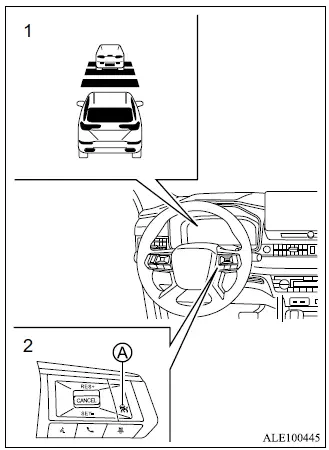
- Displays and indicators
- ACC switches
- MAIN (ONꞏOFF) switch
Push the MAIN switch A to select the desired cruise control operating mode between vehicle-to-vehicle distance control mode and conventional (fixed speed) cruise control mode.
After one cruise control mode has been activated, the system cannot be switched directly to the other mode. To change modes, push the MAIN switch A once to turn the ACC system off. Then push the MAIN switch A again to turn the system back on and select the required cruise control mode.
Always check the ACC system display after selecting a mode to confirm that the Mitsubishi Outlander is operating with the intended cruise control setting before relying on the system.
- How to select the cruise control mode
- System temporarily unavailable
- Conventional (fixed speed) cruise control mode
