
The Active stability control [ASC] system uses multiple sensors to monitor driver inputs, wheel behavior, and vehicle movement. Under certain driving conditions, ASC can help the Mitsubishi Outlander maintain traction and directional stability by performing the following functions.
- Controls brake pressure to reduce wheel slip when one drive wheel loses traction, helping transfer driving force to the non-slipping drive wheel on the same axle.
- Controls brake pressure and engine output according to vehicle speed to reduce excessive drive-wheel slip through the traction control function.
- Controls brake pressure individually at each wheel and adjusts engine output to help the driver maintain control of the vehicle under conditions such as:
- understeer, when the vehicle tends to continue straighter than the path commanded by the steering input despite additional steering effort
- oversteer, when the vehicle tends to rotate or spin because of certain road or driving conditions.
The ASC system can assist the driver in maintaining control and stability of the Mitsubishi Outlander, but it cannot prevent loss of control under every possible driving condition.
When ASC is actively operating, the ASC warning light
 in the instrument panel flashes. If this occurs, keep the following points in mind:
- The road surface may be slippery, or the system may have detected that corrective action is needed to help keep the vehicle on the intended steering path.
- You may feel pulsation through the brake pedal or hear noise and vibration from beneath the hood. These sensations are normal and indicate that the ASC system is operating.
- Reduce speed as necessary and adjust your driving style to suit current road and traction conditions.
If the system detects a malfunction, the ASC warning light
 illuminates in the instrument panel. When this happens, ASC is automatically disabled.
The ASC system can be switched off through the multi-information display. When ASC is turned off, the ASC off indicator
 illuminates to confirm that most stability control functions are disabled. Even with ASC switched off, the system can still intervene if one drive wheel slips by transferring driving force to the non-slipping wheel on the same axle. The ASC warning light
 flashes when this limited function is operating. All other ASC functions remain disabled, and the ASC warning light
 will not flash for those functions.
ASC is automatically restored to the ON setting after the ignition switch is placed in the OFF position and then returned to the ON position.
WARNING
- ASC is designed to help improve vehicle stability, but it cannot prevent accidents caused by abrupt steering at high speed, careless driving, or dangerous driving techniques. Reduce vehicle speed when necessary, use particular caution while cornering on slippery surfaces, and always operate the Mitsubishi Outlander according to road and traffic conditions.
- Do not modify the vehicle suspension. If components such as shock absorbers, struts, springs, stabilizer bars, bushings, or wheels are not recommended by Mitsubishi Motors for your vehicle, or if these parts are excessively worn or deteriorated, ASC may not operate correctly. Vehicle handling may also be adversely affected, and the ASC warning light
 may illuminate.
 - If brake-related components such as brake pads, rotors, or calipers are not recommended by Mitsubishi Motors or are excessively worn or deteriorated, ASC may not operate correctly and the ASC warning light
 may illuminate.
 - If engine-control-related components are not recommended by Mitsubishi Motors or are excessively worn or deteriorated, the ASC system may be affected and the ASC warning light
 may illuminate.
 - When driving on extremely inclined surfaces, including steeply banked corners, ASC may not operate correctly and the ASC warning light
 may illuminate. Avoid driving on roads or surfaces of this type.
 - When the Mitsubishi Outlander is positioned on an unstable or moving surface such as a turntable, ferry, elevator, or ramp, the ASC warning light
 may illuminate.
This is not a malfunction. After the Mitsubishi Outlander has been moved onto a stable surface, restart the engine to restore normal ASC operation.
 may illuminate.
How to turn off the ASC
For normal driving, the Mitsubishi Outlander should generally be operated with Active stability control [ASC] switched ON so the system can provide its available traction and stability assistance.
If the vehicle becomes stuck in mud or snow, ASC may reduce engine output to limit excessive wheel spin. Engine speed can therefore remain restricted even when the accelerator pedal is pressed fully. If maximum available engine power is required to help free the Mitsubishi Outlander, the ASC system can be temporarily turned off.
Example
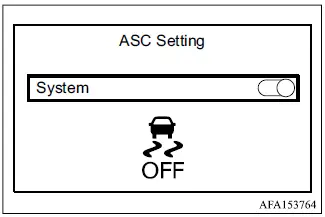
To turn ASC off, use the following procedure in the multi-information display.
1. Push the
 button on the left side of the steering wheel until "Settings" appears in the display.
2. Use the scroll dial to select "ASC Setting," and then push the dial to open the setting.
3. Select "System" and push the scroll dial to switch ASC off.
The
 indicator light will illuminate to confirm that ASC has been turned off.
To reactivate ASC, turn "ASC Setting" back on through the multi-information display or restart the engine. The system will then return to its normal ON setting.
