
Continuously Variable Transmission (CVT)
The Continuously Variable Transmission (CVT) in the Mitsubishi Outlander is electronically controlled to provide smooth operation while delivering the power needed for normal driving conditions.
The recommended procedures for operating the transmission are described in the following sections. Following these procedures will help ensure proper vehicle response, smooth transmission operation, and consistent driving performance.
Engine power may be reduced automatically to protect the CVT if engine speed rises rapidly while the Mitsubishi Outlander is being driven on a slippery surface or while the vehicle is being tested on certain types of dynamometers.
WARNING
- Do not depress the accelerator pedal while shifting from "P" (Park) or "N" (Neutral) into "R" (Reverse), "D" (Drive), or "M" (Manual shift mode). Keep the brake pedal firmly depressed until the shift has been completed.
Failure to follow this procedure could cause unexpected vehicle movement, loss of control, and an accident.
- Engine idle speed is higher when the engine is cold. Use extra caution when selecting a forward or reverse driving position before the engine has warmed up.
- Do not make abrupt downshifts on slippery roads, as this may cause the drive wheels to lose traction and could result in loss of vehicle control.
- Never shift into "P" (Park) or "R" (Reverse) while the vehicle is moving forward, and never shift into "P" (Park) or "D" (Drive) while the vehicle is moving backward.
Doing so may cause an accident or serious damage to the transmission.
- Except in an emergency, do not shift the transmission into "N" (Neutral) while driving.
Coasting with the transmission in "N" (Neutral) may cause serious transmission damage and reduces normal drivetrain control of the Mitsubishi Outlander.
CAUTION
- When stopping the vehicle on an uphill grade, do not use the accelerator pedal to hold the Mitsubishi Outlander in position. Use the foot brake instead to prevent unnecessary stress or possible damage to the transmission.
- Do not hang, attach, or place bags, pouches, or other objects around the shift lever. An object could interfere with the lever and cause it to move unintentionally, creating a risk of unexpected vehicle movement or an accident.
Starting the vehicle
1. After starting the engine, fully depress the foot brake pedal before attempting to move the shift lever out of the "P" (Park) position. The CVT is designed so that the brake pedal must be depressed before the transmission can be shifted from "P" (Park) into another driving position while the ignition switch is in the "ON" position. The shift lever cannot be moved from "P" (Park) into another position when the ignition switch is in the "OFF" position.
2. Keep the foot brake pedal fully depressed and move the shift lever into the desired driving position.
3. Release the parking brake, then release the foot brake pedal gradually and begin moving the vehicle smoothly.
CAUTION
- DEPRESS THE FOOT BRAKE PEDAL - If the shift lever is moved to "D" (Drive), "R" (Reverse), or "M" (Manual shift mode) while the engine is running and the brake pedal is not fully depressed, the vehicle may begin to move slowly. Make sure the Mitsubishi Outlander is completely stopped and the foot brake pedal is firmly depressed before changing the shift lever position.
- CHECK SHIFT LEVER POSITION - Always confirm that the shift lever is in the intended position before releasing the brake pedal.
Use "D" (Drive) or manual shift mode for forward travel and "R" (Reverse) when backing up.
- WARM UP THE ENGINE - Because engine idle speed is higher immediately after a cold start, use additional caution when moving the shift lever into a driving position before the engine has warmed up.
Shifting
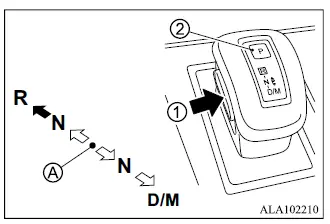
- Home position (central position)
Use the following shift lever operations to select the required transmission position:
 Push button 1 while moving the shift lever to select the indicated position.
 Move the shift lever without pushing button 1 when selecting a position that does not require the button.
Push the park button to shift the transmission into the P (Park) position.
After starting the engine, fully depress the brake pedal, push shift lever button 1, and move the shift lever from P (Park) position 2 to the desired shift position.
After making a selection, confirm that the Mitsubishi Outlander is in the intended transmission position by checking the shift indicator on the shift lever or the indication shown in the multi-information display.
WARNING
- If the engine is not running and the transmission is in any shift position, apply the electric parking brake. Failure to secure the vehicle properly could allow the Mitsubishi Outlander to move unexpectedly or roll away, resulting in serious personal injury or property damage.
CAUTION
- Select P (Park), R (Reverse), or D (Drive) only after the vehicle has come to a complete stop.
- After moving the shift lever to select the desired transmission position, release the lever and make sure it returns to its central home position. Holding the shift lever between positions or preventing it from returning normally may damage the electronic shift control system.
- Do not operate the shift lever while the accelerator pedal is depressed. The vehicle may move suddenly, which could result in an accident.
- The following shift operations are not permitted because they can place excessive force on the transmission and may damage the vehicle:
- Moving the shift lever to R (Reverse) while the Mitsubishi Outlander is traveling forward.
- Moving the shift lever to D (Drive) while the vehicle is moving backward.
If either of these operations is attempted, a warning chime will sound and the transmission will shift to N (Neutral).
P (Park)
CAUTION
- To prevent transmission damage, select P (Park) only when the vehicle is completely stopped.
- Do not move or slide the shift lever while pressing the park button, as this may damage the shift control system.
NOTE
- When the transmission is in the P position, an operating sound may be heard from the lower portion of the vehicle as part of the vehicle's evacuation operation. This sound does not indicate a malfunction.
Use P (Park) when parking the Mitsubishi Outlander or when starting the engine. Always make sure the vehicle is completely stopped before pressing park button 2 to engage P (Park). For maximum safety, keep the brake pedal depressed while selecting the P (Park) position and use P (Park) together with the electric parking brake. When parking on a hill, first hold the vehicle with the brake pedal, apply the electric parking brake, and then select P (Park). The transmission parking lock is not intended to serve as the vehicle's parking brake. To secure the vehicle properly whenever it is parked, always apply the electric parking brake in addition to engaging the parking lock.
If a malfunction occurs in the vehicle's electronic control system, the transmission may become locked in the P (Park) position. Have the Mitsubishi Outlander electronic systems inspected as soon as possible. It is recommended that this service be performed by an authorized Mitsubishi Motors dealer.
The transmission will automatically engage the P (Park) position under the following conditions:
- When the ignition switch is turned off.
- When the driver's seat belt is unfastened and the driver's door is opened while the vehicle is stationary or moving at very low speed with the transmission in D (Drive) or R (Reverse).
R (Reverse)
CAUTION
- To prevent transmission damage, select R (Reverse) only when the Mitsubishi Outlander is completely stopped.
Use the R (Reverse) position when backing up.
Always bring the vehicle to a complete stop before selecting R (Reverse).
The brake pedal must be depressed and the shift lever button must be pressed before moving the shift lever from the home position into R (Reverse). If R (Reverse) is selected while the vehicle is still moving forward, a warning chime will sound and the transmission will automatically shift to N (Neutral).
N (Neutral)
In N (Neutral), neither a forward gear nor reverse gear is engaged. The engine can be started in this position. If the engine stalls while the vehicle is moving, the transmission may be shifted to N (Neutral) so the engine can be restarted.
To select N (Neutral), hold the shift lever in the N position for approximately 0.5 seconds.
D (Drive)
Use D (Drive) for normal forward driving.
In this position, the Mitsubishi Outlander CVT automatically adjusts the transmission ratio according to driving conditions.
All forward driving ranges are available. If D (Drive) is selected while the vehicle is moving backward, a warning chime will sound and the transmission will automatically shift to N (Neutral).
Neutral hold mode function
The Neutral hold mode function allows the engine to be switched off while the transmission remains in N (Neutral). When this function is active, the Mitsubishi Outlander can be moved manually by pushing it, such as during certain car washing procedures, even with the ignition switch in the OFF position.
WARNING
- Use the Neutral hold mode function only on a level surface. If the vehicle is positioned on a slope, it may move unexpectedly and could cause a collision or serious personal injury.
- Do not use this function for any purpose other than car washing.
- When the ignition switch is placed in the ON position after Neutral hold mode has been activated, depress the brake pedal immediately to keep the vehicle stationary because the transmission remains in N (Neutral).
- The shift lever cannot be moved directly from N (Neutral) to R (Reverse).
To select R (Reverse), the transmission must first be shifted to P (Park) or D (Drive).
- If Neutral hold mode does not activate even though the correct procedure has been followed, the transmission system may have a malfunction. Have the Mitsubishi Outlander inspected immediately by an authorized Mitsubishi Motors dealer or another qualified repair facility.
To activate Neutral hold mode, perform the following procedure.
1. Push the ignition switch to start the engine.
2. Release the electric parking brake.
3. Depress the brake pedal firmly and continue holding it.
4. Push the P position switch.
5. Move the shift lever to the N (Neutral) position and hold it there for approximately 0.5 second, until "N" appears in the multi-information display.
6. Move the shift lever to the N (Neutral) position once again and hold it for approximately 0.5 second, until the message "Neutral Hold Mode has been activated" appears in the multi-information display.
7. Place the ignition switch in the OFF position.
The engine will stop while the Mitsubishi Outlander remains in the N (Neutral) position.
To cancel Neutral hold mode, shift the transmission from N (Neutral) to any other available position.
NOTE
- Steps 4 through 6 must be completed within approximately 5 seconds to help prevent incorrect operation of the Neutral hold mode function.
- When the ignition switch is placed in the OFF position while the transmission remains in N (Neutral), a corresponding message will appear in the multi-information display.
- If Neutral hold mode is unavailable, a message will appear in the multi-information display. To try activating the function again, wait briefly without operating the shift lever, then repeat the procedure.
Steering wheel paddle shift
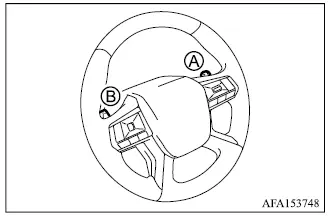
While driving with the transmission in D (Drive), moving the shift lever to the D (Drive) position again switches the transmission into M (Manual) shift mode.
In manual shift mode, the driver can select the transmission range manually using the steering wheel paddle shifters.
To shift up to a higher range, pull right-side paddle shifter (+) A.
To shift down to a lower range, pull left-side paddle shifter (−) B.
To cancel manual shift mode, move the shift lever to the D (Drive) position again.
The Mitsubishi Outlander transmission will then return to its normal automatic driving mode.
If a paddle shifter is pulled while the transmission is operating normally in D (Drive), the transmission temporarily shifts to a higher or lower range according to the selected paddle. After a short period, the transmission automatically returns to normal D (Drive) operation. To return to D (Drive) manually before this occurs, pull and hold right-side paddle shifter (+) A for approximately 1.5 seconds.
When M (Manual) shift mode is active, the selected shift range is shown in the multi-information display.
The available manual ranges can be selected one step at a time, from 1M through 8M.
8M (8th): Use this range for normal forward driving at highway speeds.
7M (7th), 6M (6th) and 5M (5th): Use these ranges when driving up long inclines or when additional engine braking is needed while descending long slopes.
4M (4th), 3M (3rd) and 2M (2nd): Use these ranges when climbing hills or when stronger engine braking is required on downhill grades.
1M (1st): Use this range when slowly climbing steep hills, driving at low speed through deep snow, or when maximum engine braking is required on a steep downhill grade.
- Avoid driving at high speeds for extended periods while using a range lower than 8M, as prolonged operation in lower ranges can reduce fuel economy.
- Pulling the same paddle shifter twice can shift through two ranges in succession. However, if the paddle is operated too rapidly, the second requested shift may not be completed properly.
- In manual shift mode, the transmission may not shift to the selected range if the requested shift is not appropriate for the current operating conditions.
This helps preserve stable driving performance and reduces the risk of vehicle damage or loss of control.
Once the CVT fluid reaches a suitable temperature, manual shift mode can be selected and used normally.
Accelerator downshift - in D (Drive) position -
When additional acceleration is required for passing another vehicle or climbing a hill, depress the accelerator pedal fully. Depending on the current vehicle speed, the Mitsubishi Outlander CVT will automatically shift to a lower range to provide stronger acceleration.
High fluid temperature protection mode
The Continuously Variable Transmission is equipped with a high fluid temperature protection mode. If the CVT fluid temperature becomes excessively high, such as when climbing steep grades in hot weather while carrying a heavy load, engine power and, under certain conditions, vehicle speed will be reduced automatically to help protect the transmission from damage. Vehicle speed can still be controlled with the accelerator pedal, although maximum engine speed and vehicle speed may be temporarily limited.
Fail-safe
When the fail-safe function is activated, the Continuously Variable Transmission may not shift into the driving position selected by the driver.
The fail-safe system may be triggered if the Mitsubishi Outlander is operated under severe conditions, such as excessive wheel spinning followed by hard braking. The Malfunction Indicator Light (MIL) may illuminate when fail-safe mode is activated.
This condition can occur even when the vehicle's electrical circuits are functioning normally. If fail-safe mode is activated, place the ignition switch in the "OFF" position and wait for 10 seconds. Then place the ignition switch back in the "ON" position.
The transmission should return to normal operation. The MIL may remain illuminated even after normal vehicle operation has been restored. If the transmission does not return to its normal operating condition, have the Mitsubishi Outlander inspected and the transmission repaired if necessary by an authorized Mitsubishi Motors dealer or another qualified repair facility as soon as possible.
WARNING
- When high fluid temperature protection mode or fail-safe operation is activated, vehicle speed may be reduced gradually.
The resulting speed may be lower than the speed of surrounding traffic, increasing the risk of a collision. Drive with particular care under these conditions. If necessary, move safely to the side of the road and stop the Mitsubishi Outlander in a safe location to allow the transmission to return to normal operation, or arrange for inspection and repair if the condition does not clear.
