CAUTION
- Pull the rear door sunshade only in the upward direction. Pulling it sideways or at an angle may damage the shade or its retracting mechanism.
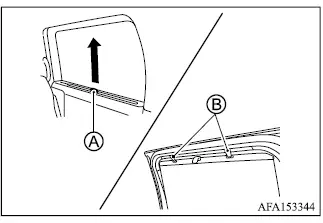
- Keep a firm grip on knob A while raising or retracting the sunshade. The shade retracts quickly, and releasing the knob unexpectedly may allow your fingers to become pinched between the sunshade and the window opening.
- Do not drive with the windows open while the sunshade is in use. If the shade becomes unhooked, a strong gust of wind could cause injury or wrinkle and damage the shade material.
Pull-up sunshades are installed on the rear door windows of the Mitsubishi Outlander to help reduce direct sunlight entering the rear passenger area.
To raise the sunshade, pull knob A upward and secure the knob into hook B at the top of the window opening.
To store the sunshade, carefully release it from the hook while holding knob A, then guide the shade downward as it retracts into its housing.
READ NEXT:
Inside mirror
Adjust the inside rearview mirror to a position that provides a clear and comfortable view through the rear window before driving.
Frameless auto dimming rearview
mirror (if so
The frameless digital rearview mirror is designed to maintain a clear view behind the Mitsubishi Outlander even when the normal rearward view is partially blocked by passengers, head restraints, lugga
MENU button
Center button
Right side button
Warning display
Camera icon
Mirror/display screen
Mode select lever
WARNING
Always adjust the frameless digital rearview mir
SEE MORE:
This section explains the operation and key functions of the following driver-assistance features available for the Mitsubishi Outlander:
MI-PILOT Assist (general system operation)
MI-PILOT Assist with Navi-link (additional
functionality, if so equipped)
WARNING
Failure to follow the
WARNING
Always keep the liftgate release lever cover securely closed while driving. Loose luggage or cargo could otherwise contact the release lever accidentally and unlatch the liftgate.
If the liftgate cannot be opened using switch A, B, or C because the vehicle battery is discharge

