
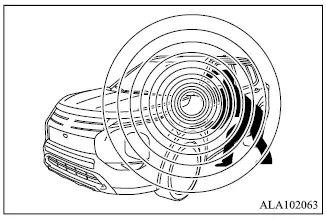
The Mitsubishi Outlander is equipped with two types of security systems designed to help protect the vehicle against unauthorized access and operation:
- Anti-theft alarm system
- Anti-theft engine immobilizer
Anti-theft alarm system
CAUTION
- Do not modify, alter, or add components to the anti-theft alarm system. Unauthorized changes or additions may interfere with proper system operation and could cause the anti-theft alarm system to fail.
The anti-theft alarm system provides both visual and audible warning signals if a door, the hood, or the liftgate is opened while the system is armed. The system is not a motion-detection alarm and therefore is not designed to activate simply because the vehicle is moved or subjected to vibration.
The system is intended to help discourage vehicle theft, but it cannot prevent theft in every situation and cannot guarantee protection against theft of components or belongings from inside or outside the vehicle. Always secure the Mitsubishi Outlander even when leaving it unattended for only a short period. Never leave the keys inside the vehicle, and make sure all doors are locked whenever the vehicle is unattended. Whenever possible, choose a secure and well-lit parking location and remain aware of the surrounding area.
If the anti-theft alarm system does not operate as expected or you have questions about its operation, contact an authorized Mitsubishi Motors dealer for inspection or assistance.
How to arm the anti-theft alarm system
1. Close all windows. The anti-theft alarm system can still be armed when one or more windows are open.
2. Remove the keys from the vehicle.
3. Close all doors, the hood, and the liftgate, then lock all doors. The vehicle can be locked using the transmitter, the door handle request switch (if so equipped), or the liftgate request switch (if so equipped).
4. The armed mode becomes active after approximately 30 seconds.
The anti-theft alarm system can become active even when the driver and/or passengers remain inside the vehicle, provided all doors, the hood, and the liftgate are locked and the ignition switch is placed in the LOCK position.
NOTE
- The alarm system will not be armed if the doors and liftgate are locked using the mechanical key or the interior door lock knob instead of the transmitter, door handle request switch (if so equipped), or liftgate request switch (if so equipped).
Anti-theft alarm system activation
When the anti-theft alarm system is triggered, it provides the following warning signals:
- The headlights flash while the horn sounds intermittently.
- The alarm automatically stops after approximately 30 seconds. If the Mitsubishi Outlander is tampered with again, however, the alarm will reactivate.
The alarm can be activated by the following conditions:
- Opening any door, the hood, or the liftgate without using the transmitter, door handle request switch (if so equipped), or liftgate request switch (if so equipped). The alarm may activate even if a door is unlocked by releasing the interior door lock knob.
- The vehicle battery is disconnected.
NOTE
- Even after the alarm has stopped, it will activate again if another unauthorized action is detected.
How to stop an activated alarm
The activated alarm can be stopped by unlocking a door or the liftgate using the UNLOCK
 button on the transmitter. The alarm can also be stopped by pushing the request switch (if so equipped) on the driver's door, front passenger's door, or liftgate while the transmitter is within the operating range of the corresponding door handle or liftgate request switch.
The alarm will also stop when the ignition switch is placed in the ON position.
Anti-theft engine immobilizer
CAUTION
- Do not modify, alter, or add components to the immobilizer system. Changes to the system may interfere with its operation and could cause the immobilizer to malfunction.
The anti-theft engine immobilizer prevents the Mitsubishi Outlander engine from starting unless a properly registered key is used.
If the engine does not start when a registered transmitter is being used, communication between the transmitter and the vehicle may be affected by interference from nearby devices or equipment, including:
- Another transmitter.
- Automated toll road device.
- Automated payment device.
- Other devices that transmit similar signals.
Try starting the engine using the following procedure:
1. Move any objects or devices that may be causing signal interference away from the transmitter.
2. Attempt to start the engine again.
If the engine starts after following this procedure, Mitsubishi Motors recommends keeping the registered transmitter separated from other electronic devices that may interfere with its signal.
NOTE
- The key may not operate correctly when it is used near an object, device, or facility that produces strong electromagnetic waves.
- The anti-theft engine immobilizer is not compatible with commercially available remote starting systems. Installing or using an aftermarket remote starting system may cause engine-starting problems and may reduce the security protection provided by the immobilizer.
Statement related to section 15 of FCC
rules for Anti-theft engine immobilizer
(CONTROL UNIT, KOS)
FCC Notice:
For USA:
FCC ID : KR5MTXN1
FCC ID : KR5HFM401
This device complies with Part 15 of the
FCC Rules. Operation is subject to the following two conditions: (1) this device
may
not cause harmful interference, and (2)
this device must accept any interference
received, including interference that may
cause undesired operation.
CAUTION
- Changes or modifications not expressly approved by the party responsible for regulatory compliance could void the user's authority to operate this equipment.
For Canada:
IC ID : 7812D-MTXN1
IC ID : 7812D-HFM401
This device complies with Industry Canada licence-exempt RSS standard(s).
Operation is subject to the following two conditions: (1) this device may not cause interference, and (2) this device must accept any interference, including interference that may cause undesired operation of the device.
Le présent appareil est conforme aux CNR d'Industrie Canada applicables aux appareils radio exempts de licence. L'exploitation est autorisée aux deux conditions suivantes : (1) l'appareil ne doit pas produire de brouillage, et (2) l'utilisateur de l'appareil doit accepter tout brouillage radioélectrique subi, même si le brouillage est susceptible d'en compromettre le fonctionnement.
