
NOTE
- When conventional (fixed speed) cruise control mode is selected, MI-PILOT Assist does not provide approach warnings, automatic braking, or Lane Keep Assist [LKA].
This mode allows the Mitsubishi Outlander to maintain a selected cruising speed between 20 and 90 MPH (30 to 144 km/h) without requiring the driver to keep continuous pressure on the accelerator pedal.
WARNING
- In conventional (fixed speed) cruise control mode, no warning chime is provided if the Mitsubishi Outlander becomes too close to a vehicle ahead because the system does not detect either the presence of the preceding vehicle or the distance between the two vehicles.
- Always monitor the distance between your vehicle and traffic ahead carefully. Failure to maintain a safe following distance could result in a collision.
- Always confirm the selected operating mode and system status in the ACC display before relying on cruise control.
- Do not use conventional (fixed speed) cruise control mode under any of the following driving conditions:
- When road or traffic conditions make it difficult to maintain a constant preset speed.
- In heavy traffic or when surrounding traffic frequently changes speed.
- On winding, curved, or hilly roads.
- On slippery roads caused by rain, snow, ice, or similar conditions.
- In areas exposed to strong or gusty winds.
- Using conventional cruise control under unsuitable conditions could result in loss of vehicle control and an accident.
Conventional (fixed speed) cruise control switches
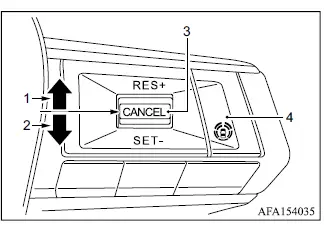
- RES+ switch:
Resumes the previously set vehicle speed or increases the selected cruising speed incrementally - SET- switch:
Sets the desired cruising speed or reduces the selected speed incrementally - CANCEL switch:
Temporarily deactivates cruise control without deleting the stored vehicle set speed - MI-PILOT Assist switch:
Turns the MI-PILOT Assist system on or off and is also used to select the desired cruise control mode
Conventional (fixed speed) cruise control mode display and indicators
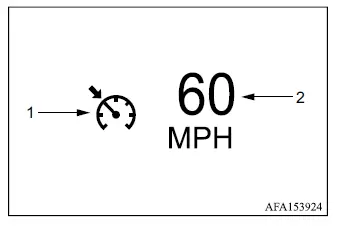
The conventional cruise control information is shown in the multi-information display.
- Cruise indicator:
This indicator shows the current operating condition of the ACC system according to its color.- Cruise control ON indicator (gray): Indicates that the MI-PILOT Assist switch is on and conventional cruise control is ready to be set
- Cruise control SET indicator (green): Indicates that a cruising speed has been selected and is currently set
- Cruise control warning (orange): Indicates that a malfunction has been detected in the ACC system
- Set vehicle speed indicator:
This indicator displays the cruising speed currently selected by the driver.For Canadian models, the selected speed is displayed in km/h.
Operating conventional (fixed speed) cruise control mode
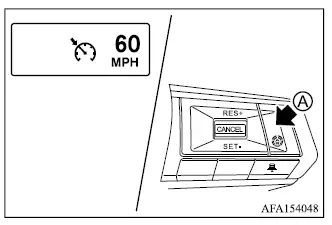
To activate conventional (fixed speed) cruise control mode, push and hold the MI-PILOT Assist switch A for longer than approximately 1.5 seconds.
When the MI-PILOT Assist switch is initially pushed, the system display and related indicators appear in the multi-information display. Continue holding the MI-PILOT Assist switch for longer than approximately 1.5 seconds. The ACC vehicle-to-vehicle distance control display then turns off and the conventional cruise indicator appears, confirming that fixed-speed cruise control mode is ready for a cruising speed to be set. Pushing the MI-PILOT Assist switch again turns the system completely off. The system is also switched off automatically when the ignition switch is placed in the OFF position.
To use the ACC system again, quickly push and release the MI-PILOT Assist switch to select vehicle-to-vehicle distance control mode, or push and hold the switch again to activate conventional (fixed speed) cruise control mode.
WARNING
- To prevent accidental activation of cruise control, make sure the MI-PILOT Assist switch is turned off whenever the ACC system is not being used.
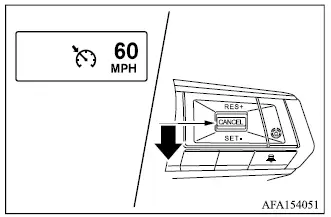
To set the cruising speed, accelerate the Mitsubishi Outlander to the desired speed, push down the SET- switch, and release it. The cruise indicator changes to green and the set vehicle speed indicator illuminates. Remove your foot from the accelerator pedal and the vehicle will maintain the selected speed as long as operating conditions permit.
- To pass another vehicle, depress the accelerator pedal as necessary. After the pedal is released, the Mitsubishi Outlander will return toward the previously selected cruising speed.
- The vehicle may not be able to maintain the preset speed while traveling up or down steep hills.
If this occurs, manually control vehicle speed using the accelerator or brake pedal as necessary.
To cancel the preset vehicle speed, use any of the following methods:
1. Push the CANCEL switch. The set vehicle speed indicator will turn off.
2. Lightly depress the brake pedal. The set vehicle speed indicator will turn off.
3. Turn the MI-PILOT Assist switch off.
Both the cruise indicator and the set vehicle speed indicator will turn off.
NOTE
- Under any of the following conditions, conventional (fixed speed) cruise control mode is automatically canceled and a warning chime sounds.
- When the Mitsubishi Outlander is traveling below 15 MPH (25 km/h).
- When ASC, including the traction control system, is operating.
- When one or more wheels are slipping.
- When the shift lever is not in the D (Drive) position or manual shift mode.
- When the electric parking brake is applied.
- When ASC is switched off.
- When the FCM system applies braking.
- When the cruise control or ACC system detects a malfunction.
- When SNOW mode, MUD mode on AWC models, or GRAVEL mode is selected.
To reset the system to a faster cruising speed, use any one of the following three methods:
1. Depress the accelerator pedal. When the Mitsubishi Outlander reaches the desired speed, push down and release the SET- switch to store the new cruising speed.
2. Push up and hold the RES+ switch. When the vehicle reaches the desired higher speed, release the switch.
3. Push up and quickly release the RES+ switch. Each operation increases the set vehicle speed by approximately 1 MPH (1 km/h).
To reset the system to a slower cruising speed, use any one of the following three methods:
1. Lightly depress the brake pedal. When the vehicle slows to the desired speed, push down and release the SET- switch.
2. Push down and hold the SET- switch.
Release the switch when the Mitsubishi Outlander slows to the desired cruising speed.
3. Push down and quickly release the SET- switch.
Each operation decreases the set vehicle speed by approximately 1 MPH (1 km/h).
To resume the previously stored vehicle speed, push up and release the RES+ switch. The Mitsubishi Outlander will return to the last selected cruising speed when vehicle speed is above 20 MPH (30 km/h).
