
Mitsubishi Outlander: Cargo area cover
To use
1. Draw out the cover retracted by spring and insert it in the mounting grooves (A).
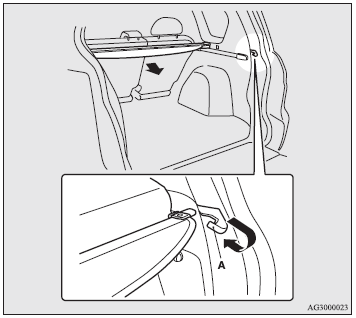
2. Remove the cover from the mounting grooves, and the cover will be rolled back into the retracted position.
NOTE:
● Do not put luggage on the cargo area cover.
To change
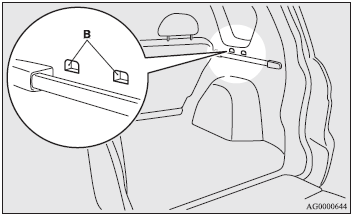
There are 2 installation holes (B) for the cargo area cover.
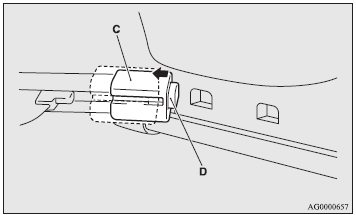
1. Move one of the sliders (C) toward the inside of the vehicle, and fit the tab (D) into the installation hole that is to be used. Move the opposite slider in the same fashion.
2. After changing the position, gently shake the entire cargo area cover to make sure it is securely retained.
NOTE:
● If the rear seat seatbacks make contact with the cargo area cover, move back the cargo area cover.
The cargo area cover could break if it supports the seatback of the rear seat.
To remove
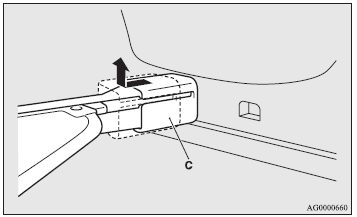
1. Wind up the cargo area cover.
2. Move one of the sliders (C) toward the inside of the vehicle and lift it to remove the cargo area cover.
To fit the cargo area cover, follow the removal steps in reverse.
Gently shake the entire cargo area cover after fitting it to make sure it is securely retained.
READ NEXT:
 Luggage hooks
There are 4 hooks located on the floor and side walls of the luggage area.
Use the hooks on the floor for securing the luggage.
CAUTION:
● Do not pile up the luggage beyond the seatback hei
If the vehicle breaks down
If the vehicle breaks down on the road, move it to the shoulder and use the hazard
warning flashers.
Refer to “Hazard warning flasher switch”.
If the engine stops/fails
Vehicle operation and
SEE MORE:
Economical driving
For economical driving, there are some technical requirements that have to be
met. The prerequisite for low fuel consumption is a properly adjusted engine. In
order to achieve longer life of the vehicle and the most economical operation, we
recommend you to have the vehicle checked at regular
For cold and snow weather
Ventilation slots
The ventilation slots in front of the windscreen should be brushed clear after
heavy snowfall so that the operation of the heating and ventilation systems will
not be impaired.
Weatherstripping
To prevent freezing of the weatherstripping on the doors, bonnet, etc., they
sh
